As hilarious as it is terrible – the thought processes that keep men inadvertently (and sometimes deliberately) supporting rape culture are so brilliantly articulated that even with the seriously funny spin, I still end up crying at the end no matter how many times I watch it.
Sexual Assault
“Not totally believable.”
Standard When I sat down at the computer this morning and noticed that a two star review had come through on Amazon for Leaving Dorian, I immediately assumed that a first edition copy had once again slipped through the cracks. I have disclaimers on all of my media letting readers know that if they’re given the option of purchasing a first or second edition copy, second edition is always going to be a better read. I was the newbie of all newbies when I published Leaving Dorian back in 2014 and didn’t realize the importance of hiring a professional editor. Since there’s no way to put that genie back in the bottle, I simply cross my fingers and hope that potential readers take the disclaimer to heart and purchase a second edition. But when I scrolled down to read the review, I was surprised to find that there was no mention of poor editing.
“The book is ok. A little frustrating in its organization and lacking some of the spark of other similar stories. Not totally believable.”
Now I know that the ‘organization’ the reader is referring to is my back and forth style of writing. I go from the day that I left my ex-husband in one chapter to describing my childhood and then back again. I understand how this can be confusing to some people, especially if they don’t get through the book in a couple of sittings. So, no harm no foul. The fact that the reader thought that it lacked ‘spark’, well, that’s his/her opinion and they’re entitled to that. But what made me literally laugh out loud was the last sentence: “Not totally believable.”
Whaaaaat?
Not believable?
I sat there at the keyboard, chuckling to myself. Not sure how to remedy that; it’s my actual, real and true life, so…..yeah. The reality is that I went easy on the graphic details of my childhood and my first marriage on purpose, because I vividly recall having to read an extremely graphic memoir about child abuse when I was in college. It was so horrible, so graphic, that it made my skin crawl; reading it made me cry and feel physically ill. Though it was a relatively short read, more than once I had to put it down because I felt as though the details were just too awful to know. Though I wasn’t sure just exactly what I was going to share when I sat down to write Leaving Dorian, I knew for sure that if nothing else, it had to be readable. If it wasn’t something that people could sit with then it couldn’t do its job, which was to help victims and survivors of abuse.
Again, though, readers are entitled to their opinion and if this reader didn’t believe everything that I’d written, well then, so be it; I can’t fix that. I clicked off Amazon and went on with my morning, but I couldn’t help coming back to that last line, “Not totally believable.” Why did it bother me so much?
I guess what’s bothering me has little to do with that singular review. What’s bothering me is that I know very well that victims and survivors of abuse are met every single day with that very same skepticism. Are their friends, loved ones, co-workers and neighbors coming right out and saying, “I don’t believe you”? No. But responding to a women’s candid, heart-wrenching admission that they’ve experienced something tragic with questions like, “Why didn’t you say something sooner?”, “Why didn’t you call the police?” or “Are you sure it’s abuse? I mean, couples fight; don’t make more out of this than it needs to be” is exactly the same sentiment. It’s “I don’t believe you” wrapped up in feigned moderation, excessive caution and good judgement. (…We don’t want to accuse someone unfairly, now; let’s make entirely sure we have all the facts before we start ruining reputations and upending lives…) Isn’t it interesting, though, how often it’s the abuser that’s given the benefit of the doubt instead of the victim?
Students and DV service providers have asked me on more than one occasion what I think the most important thing is that you can say to a victim or survivor of abuse. That if I only had one sentence, what would I choose? My answer is, and will always be, “I believe you”.
To continue to diminish victims and survivors with the old, worn out stories of supposed liars, “Oh, I know so-and-so whose wife lied about him hitting her and he got thrown in jail and it was total BS…” or “There was this girl when I was in college that lied about being raped and the guy she accused got kicked out of school and his life was ruined forever…” is unfair at best and harmful at worst. People lie, it’s true. And people will lie about all sorts of things, for reasons that aren’t always entirely clear. But the chances that a woman is lying when she finally steps forward to tell her story and reach out for help is incredibly slim. More often than not, victims and survivors are actually holding back; keeping the really hurtful, humiliating details to themselves. Telling just enough to get the help and services that they need in order to re-start their lives and keep their families afloat.
Maybe that reader didn’t believe my story, and that’s fine with me. But to every victim and survivor out there who reads this blog post, no worries. There are multitudes of people out there who will believe you. Reach out for help. Tell. Get to safety. Re-start your lives; you deserve nothing less.
And just for the record, “I believe you”.
Fall Semester, 2016
Standard Five schools, hundreds of students. I remember their faces and many of their names. More than once this semester I looked out at them looking back at me and thought, “This is crazy; how in the world did I get here?”
Well, I’m here primarily because while I thought that typing “The End” was the end, there’s a growing body of professors and helping professionals who have decided that Leaving Dorian is only a beginning.
When asked the first time if I would speak to a group of college students – as a sort of companion piece to the book – I was extremely hesitant. I didn’t think I had anything left to offer. I remember asking my husband, “I’ve already exposed my soul on paper; what else is there?” Turns out there are volumes that remain unwritten and there are students who are eager to read each and every page.
Because each class is learning about intimate partner violence from a different perspective, what I’ve set out to do is to become a living research project, of sorts. I encourage the students to poke around – to take a good look around my mind and heart and see for themselves what abuse looks like from the inside out. The goal is to see if they can connect the dots from my experience to what they’ve learned about in class.
The opportunity that I offer them isn’t an easy one; it takes real courage to look someone in the eye as you’re cutting them open, even when they’re the one who handed you the scalpel. But these young adults rise to the challenge; they take that scalpel and they cut and try and peel back the layers. They poke around and try and find the answers that they’ve read about but have not seen with their own eyes. Sometimes they find what they’re looking for easily and we build on their enthusiasm by cutting a little more, digging a little deeper. Other times I don’t have the answer; I don’t know exactly what they’re looking for (sometimes they don’t really know, either) and I ask them to try again. Cut again, I encourage them. Keep digging. Here, I’ll help you. They cut here and see what’s under there; they dig and I encourage them and their professors guide them and we, as a collective, try to extract the answers.
I’ve received stacks of glowing student evaluations this semester, most of which describe me as “brave”, “courageous” and “inspirational”. It’s heartening to know that the students view me in this way, but I have to admit that I would describe them in exactly those same terms; studying to be a helping professional isn’t for the faint of heart.
Fall semester 2016 was fantastic and I’m looking forward to revisiting new students in these courses again during the Fall of 2017!

The Niagara University campus was WINDY that evening, though my frazzled appearance might also have something to do with the fact that I spent three hours hashing it out with these students from Dr. Dana Radatz CRJ 585 Domestic Violence class. I have real affection for this group, as I still see many of them when I visit the NU campus for other DV related events.
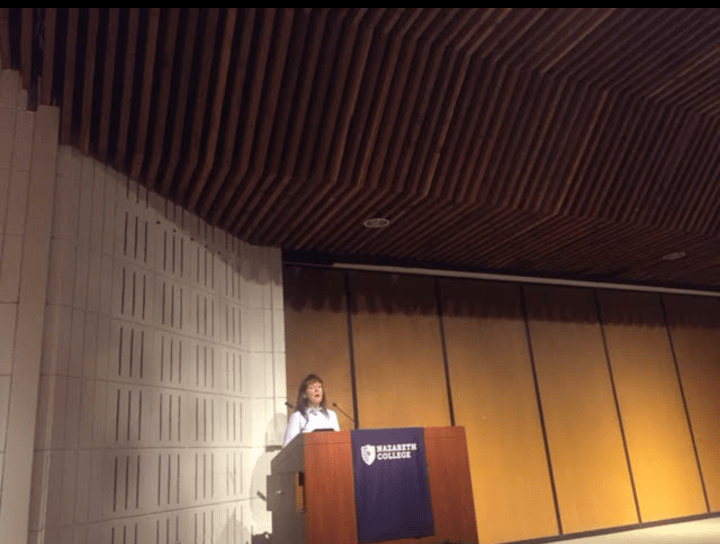
You just never know what you’re walking into when you visit a campus for the first time. Nazareth’s Health Center brought me in for an evening presentation in support of DV Awareness Month. The podium was unlike any I’d used before (short!) and I couldn’t see my notes, even with my readers on. I tried to remedy the situation by kicking off my heels about ten minutes in but as it turned out, shorter wasn’t better. So… I ended up delivering the entire presentation sans shoes, notes and readers 🙂

Because it was a campus-wide event, there were faculty and students from many different disciplines in attendance. Such great questions for me and interesting discussion afterward! I also loved that I was able to spend extra time with students who wanted to speak with me one-on-one long after the scheduled presentation time had come and gone.
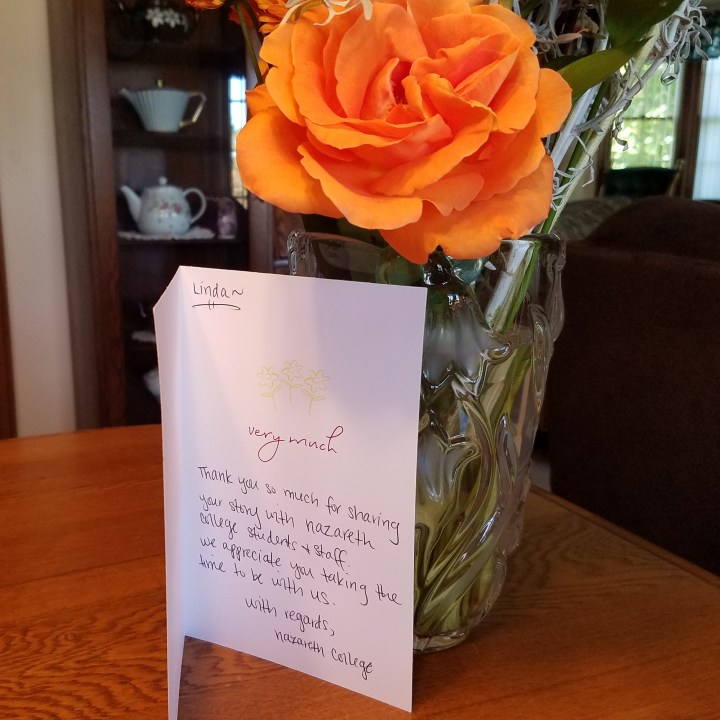
Presented to me by the Health Center interns: “Thank you so much for sharing your story with Nazareth College students and staff. We appreciate you taking the time to be with us.”

Two day event in the Finger Lakes region for Hobart and William Smith Colleges.
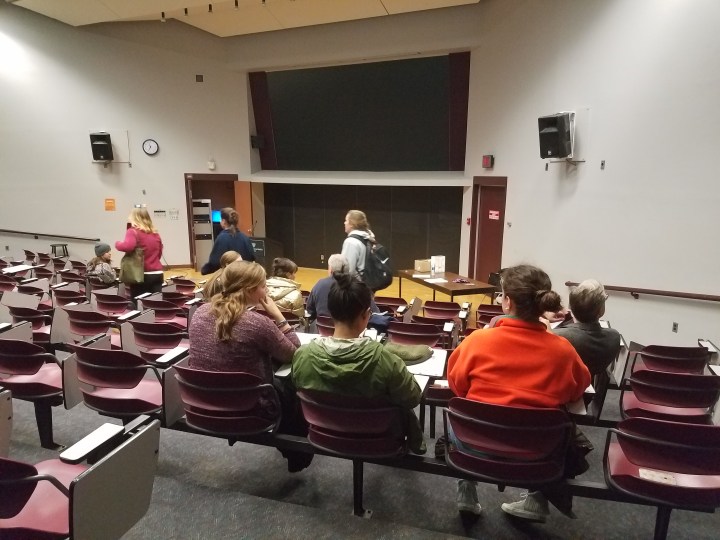
The room filled up with students and professors pretty quickly (past and present – some even brought their parents!) but there were folks from the community in attendance, as well.

Talking about Emily Carson, a young mother of three who was murdered in downtown Geneva in February of 2016. She was shot twice by her boyfriend before he turned the gun on himself. It all happened one quiet Sunday morning while dozens of innocent bystanders became unintentional witnesses. His family was quoted afterward as saying that he “…wasn’t a violent guy.” I talk about how quickly an emotionally abusive relationship can turn violent, especially once a victim leaves or tries to leave.
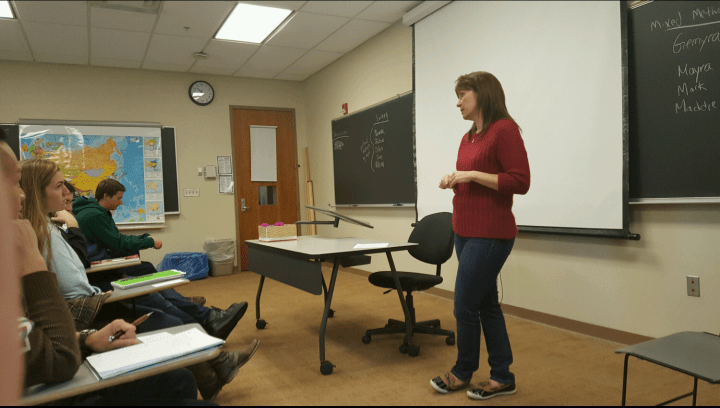
And this is how we do it – taking questions from Dr. Jim Sutton’s undergraduate Social Deviance class, Hobart & William Smith Colleges.

Book signing 🙂 By the end of the class, many of the students are comfortable enough to share their own stories with me. Honestly, this is my favorite part of any presentation – meeting the students one-on-one!
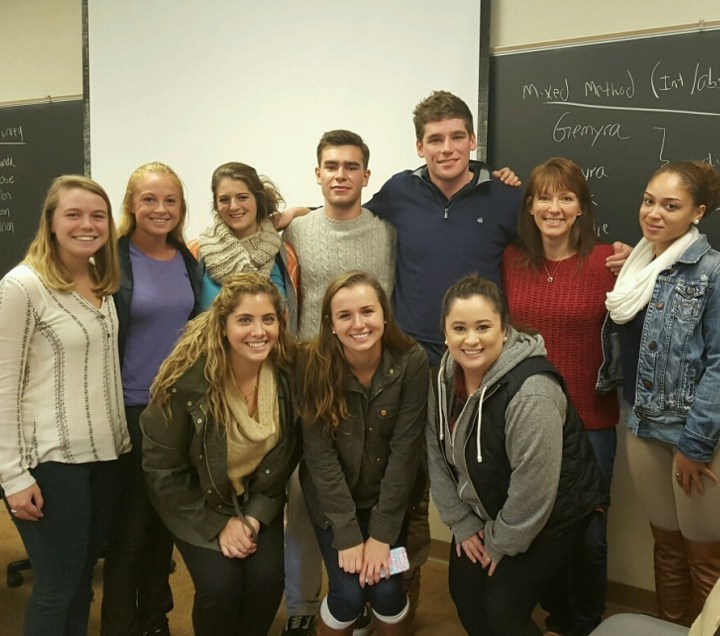
I wish my own children were as enthusiastic about having their picture taken with me as my students are! About half of the class is pictured here.

I always take a very relaxed approach to presentations because the material can get extremely graphic and emotional. Reactions run the gamut; there are students who spend the entire class period furiously scribbling notes while others will cringe, get visibly agitated or need to leave the room to compose themselves. There are always survivors of violence in the room – always – and Dr. Noelle St. Vil’s Social Work class at the University at Buffalo was no different.
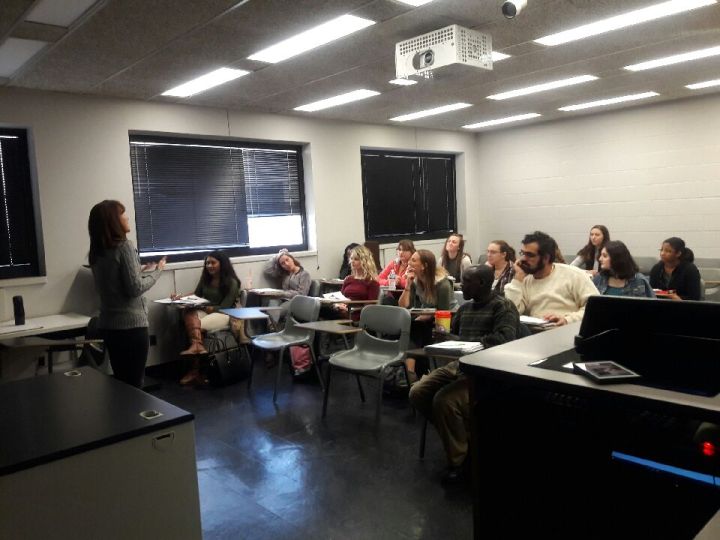
It was very early on in this “public speaking” thing that I realized that I was going to need to sprinkle in a little levity here and there. When I smile, the students smile. When I poke fun, they laugh. It’s an essential element to making sure that the students can “hear” me. Yes, I tell them, what I lived through is terrible and no, it wasn’t fair and yes, I bear the scars of it – but – my life continues to move on and here are some of the dozens of silly, crazy, ridiculous stopping blocks I’ve had to overcome in the years since I left.
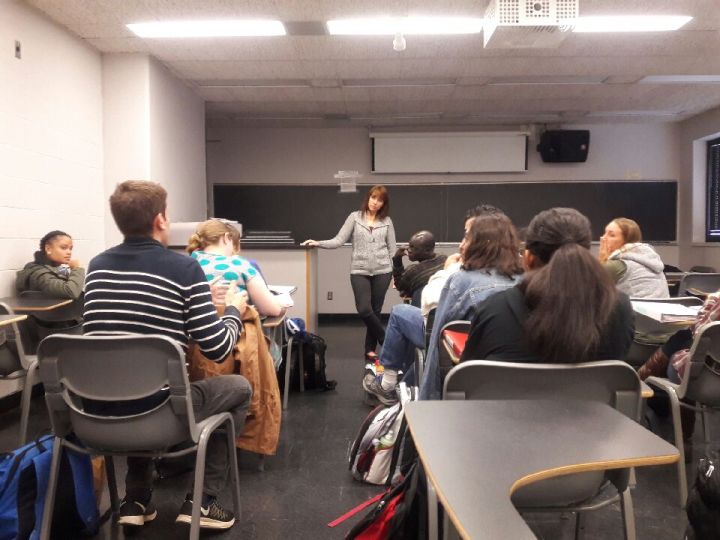
Many graduate students are already working in the field; staffing shelters, working at local help centers or with law enforcement. Their timely, real-world anecdotes are helpful in generating discussion that goes beyond my experience and what they’ve learned about in class.

I’d never Skyped a class before, so I was more that a little concerned that I wouldn’t be able to gain the emotional momentum needed to connect with the students. Happily, within minutes I realized that it wasn’t going to be an impediment; the students in Dr. Angie Moe’s SOC 4950 Family Violence Class at Western Michigan University made the best of the unusual set-up and filled the hour with really thoughtful, specific questions.
 Linda Dynel