
“Think About It” Thursdays

Standard

20161113_070014“During the 19th century, some legal actions were taken to address the most extreme forms of battering. However, since battering was socially and legally acceptable, most of these new laws were simply intended to regulate the level of violence used and the severity of injury allowed. Examples of such laws ranged from the common law rule of thumb to more modern certain rule and stitch rule. The certain rule of the mid-1800s indicated that no outside interference would occur in wife battering unless the husband created a permanent injury to the wife. The stitch rule of the early 1900s cautioned men not to cause injuries requiring stitches because police could be called to intercede in such situations….laws concerning battering developed from a foundation of acceptability and regulation rather than one of social disapproval and criminalization.”

*Excerpted from Self-Defense and Battered Women Who Kill: A New Framework , Ogle/Jacobs, (2002)

“Surviving…Thriving: A Journey of Healing Through Art” Castellani Art Museum, October 27, 2016

Standard

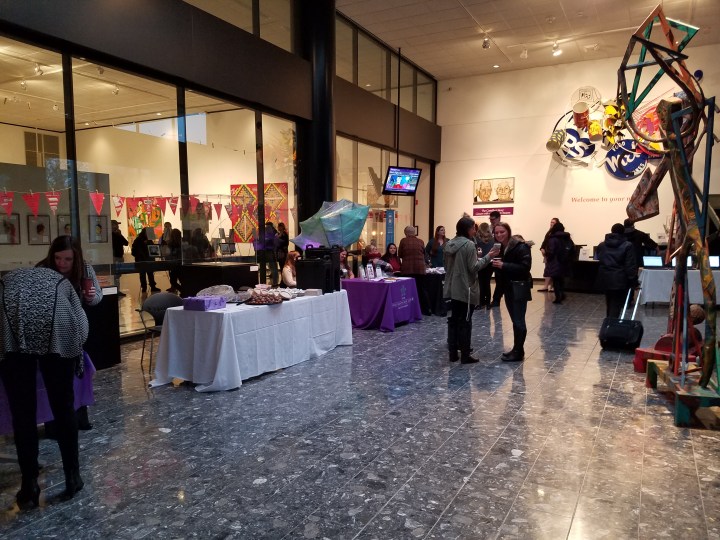
Music played softly in the gallery and advocates from local help agencies answered questions and offered information and guidance at tables set up in the lobby as students, faculty and members of the surrounding community viewed about 80 pieces of art created by survivors of domestic violence in a special exhibit at Niagara University’s Castellani Art Museum.

“This is the first year Niagara University has been part of the event. NU students have created a red flag – part of the national Red Flag Campaign, which addresses the red flags of dating violence, said Karrie Gebhardt, director of domestic violence and parenting services at Family and Children’s Services of Niagara. The initiative is a campaign to remind people to ‘say something’ if they see the signs of dating violence in a friend’s relationship. Some of the red flags include, coercion, jealousy, stalking, emotional abuse, sexual assault, isolation and victim blaming.

Eileen Wrobel, a Niagara Falls Police domestic violence victim advocate, facilitated the art exhibit with survivors through the Windows Between the Worlds art program.” – Nancy Fisher, Buffalo News, October 20, 2016

20161027_165301

“No matter what anyone says or how they try and justify the behavior, it is not O.K. to be treated poorly by anyone. Especially when they call it love.”

20161027_165616

This is the piece that brought me to tears; even now, it’s hard for me to look at.

20161027_165504

“If I can say anything to convince you to leave before it’s too late, (I’d say) ‘It’s not worth it and there is better love.’ I am a survivor by the grace of God.”
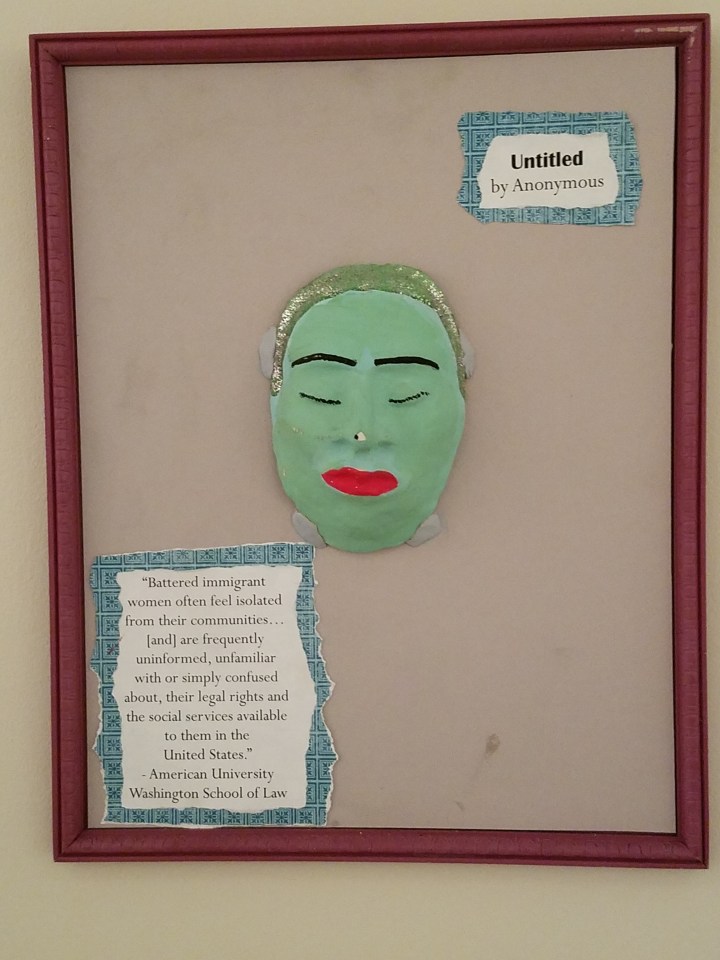
20161027_165955

I had a student ask me at a recent event if her friend (who is being battered, but who is also struggling with immigration issues) would be arrested and/or deported if she reached out to authorities for help. The above piece perfectly illustrates this often times overlooked issue.

20161027_165846

Oil on canvas

20161027_165712

The Silent Witness Project is a traveling project created in 2016 by high school senior Andrew Villella as his Eagle Scout Project. It is a reconstruction of the original life-sized project built in 2006 when there were only nine victims. Each figure represents an individual who once lived in Niagara County whose life was ended violently at the hands of a spouse, former spouse or intimate partner.

20161027_170006

More than 200 students attended this eye-opening event

20161027_170031

Dr. Dana Radatz, Criminology professor at Niagara University, was instrumental in bringing this event to fruition.
20161027_170123

The YWCA, The Child Advocacy Center of Niagara and Niagara University’s Counseling Center were among the community and campus based help centers who donated their time in order to offer information and guidance to those in attendance.

20161027_165048

A big “Thank You” to Karrie Gebhardt for graciously sharing the Family & Children’s Services table so that Leaving Dorian might be displayed.

“A Tribute To Women” The YWCA of the Niagara Frontier 2016 Niagara Awards

Standard
ywcazonta

The fantastic women who nominated me – Representing The Zonta Club of Niagara Falls, NY – Janice Lewis, Kyle Patterson and Bonnie Crogan-Mazur. I was surprised and extremely honored to win the “Entrepreneur” category.

Upon acceptance of the beautiful award I said: “Leaving Dorian had been out for about a year when I received an email from Bonnie Crogan-Mazur asking if I would like to come and speak to the ladies of The Zonta Club of Niagara Falls at one of their meetings. Now what I wanted to say was, ‘No! No I DO NOT want to come and stand in front of a group of strangers and talk about my book and my  own experience with domestic violence. I’m extremely shy by nature which is why I’m a writer; I sit in front of a computer all day by myself. That is my comfort level…!’ But instead I said ‘yes‘ and I’m so glad that I did. The ladies of The Zonta Club of Niagara Falls completely changed the trajectory of my career. I simply wouldn’t be where I am today with out them and I will be forever grateful.”

** cue ugly cry……. :/

Academic Reviews of “Leaving Dorian”

Standard

“I (enjoyed) your eloquent book (Leaving Dorian). The writing was great and I loved the way you juxtaposed the leaving chapters, reminding everyone it is a process, not a single event, with the rest of the relationship. The details were all too familiar from dozens of other similar cases, many with not such happy endings. I think we need to put a much greater emphasis on the ‘safety work’ women do after they get out.” – Evan Stark, Ph.D, MSW, Professor Emeritus, Rutgers University and author of “Coercive Control: How Men Entrap Women in Personal Life”

“Linda Dynel’s Leaving Dorian is an impactful read, and one I assign regularly in my graduate Domestic Violence courses. Leaving Dorian provides my students with insights on the adversities and challenges that survivors may experience, both during and after their violent relationship. Further, Dynel’s book highlights foreshadowing life experiences prior to her relationship with Dorian, which help students understand risk factors and red flags associated with unhealthy relationships, as well as the evolution and cyclical nature of domestic violence. Assigned as the first book of the semester, my students consistently discuss and relate Dynel’s book to other class readings and material throughout the remaining semester, and frequently share that it is their favorite read of the class. It is readily apparent that Leaving Dorian resonates with them long after they finish reading the book, as it provides students with a glimpse into one survivor’s harrowing journey to escape relationship violence. In short — Dynel’s Leaving Dorian is a must read!” – Dana L. Radatz, Ph.D., Assistant Professor, Criminology & Criminal Justice, Niagara University

“Linda Dynel’s gripping account of the ongoing abuse she endured while living with her now ex-husband Dorian serves as a wake-up call to all human service professionals. Not only must we conduct assessments of our clients we fear may be at-risk for domestic violence but reach out into the communities where we work.  As Ms. Dynel reveals in her book, domestic violence is insidious: victims of abuse are often not in a position to reach out for help on their own behalf. Instead, it is incumbent on professionals to become more attuned to the dynamics of domestic violence; educate other health and human service professionals to do the same; and advocate on behalf of victims for services that are adequate, appropriate, and accessible.” – Robert H. Keefe, PhD, ACSW, Associate Professor, University at Buffalo School of Social Work  

“I chose Leaving Dorian for my Domestic Violence course based on the recommendation of a respected Victimologist. I am SO glad I did. The book served as the ‘focal point’ of our entire semester, and we were able to apply all of the principles we’d discussed in class about intimate partner violence to Linda’s real experience. For my students, some of the aspects of the book that stood out were religious abuse, psychological abuse, the effect of abuse on children, and how truly hard it is for a person to leave an abusive situation. We spent an entire week of class time just discussing this book in detail. I have had several students tell me this was the most worthwhile read of our entire semester together; it is an easy and powerful read that moves at a fast pace. I am so grateful Linda wrote about her harrowing ordeal in such detail. I truly believe this book has changed my students’ lives.” – Dr. Danielle Slakoff, Assistant Professor of Criminology and Justice, Loyola University New Orleans

“The DV community owes you a huge thank you for putting yourself out there so honestly and bravely. It’s quite common and easy for people who haven’t been in a violent relationship to pass judgement, especially when kids are involved. You so effectively dispelled many of the common stereotypes, which is just so critical in higher ed. I can lecture until I’m blue in the face but it doesn’t have near the impact of a first hand account. The other piece that will be so effective is the support you will provide other survivors. It is very easy (for victims) to feel alone and to think you’re the only person this happened to. As an academic-activist, I can also say that it was very helpful to come across your book as there does not seem to have been much published from a personal account in recent years.” – Dr. Angie Moe, Professor of Sociology, Western Michigan University

“I decided to use Leaving Dorian because it humanizes topics we cover in my class.  I always cover topics pertaining to men’s violence against women, and I like to use items that help students better understand these topics in ways that go beyond the sensationalized (and depersonalized) ways in which they typically hear about them.” – Dr. James Sutton, Hobart and William Smith Colleges 

“I REALLY liked the book – found it very engaging and hard to put down, though it was also painful to read. It’s the kind of story that a LOT of women can relate to. It is a very fine contribution to the growing body of literature on this horrendous problem of intimate partner abuse.” – Dr. Maureen Hannah, NYS Licensed Psychologist and Professor of Psychology, Siena College

Ready

Standard

ribbonI receive dozens of posts on my Facebook feed every day from a variety of different domestic violence help centers, each working in their own way to support victims and survivors. I also receive invitations to fundraisers in support of shelters and notifications on legislation that will help (and unfortunately, sometimes hurt) victims and their families. And of course, mixed in with all of that, I also receive plenty of little inspirational quotes. I usually don’t mind them; they’re typically paired with a lovely picture and it can be refreshing to be inundated with that sort of positivity after hours spent staring at my computer screen. Some are silly, but most are uplifting and so profound in their simplicity that I wonder why I didn’t think of them myself. There would have been no need to write a whole book if I could only have pared my message down to eight or ten beautifully written and impactful words! Yet every once in a while I’ll see one that gives me pause; I’ll sit and stare at it and think, “Why would the person who posted this have thought that it was appropriate for their page?” since, generally speaking, the pages in question are usually meant to be read by victims and survivors of DV.

That’s what happened yesterday; a post came through that was attributed to Hugh Laurie. It read, “It’s a terrible thing, I think, in life to wait until you’re ready. I have this feeling now that actually no one is ever ready to do anything. There is almost no such thing as ready. There is only now. And you may as well do it now. Generally speaking, now is as good a time as any.” At first glance I thought, “Well, sure,” and kept scrolling. But then I thought, “Wait a minute; what?” I scrolled back and re-read it and began to wonder: is that really the message we should be sending to women who are living with DV?

Ready. On its surface and to anyone who’s never lived with DV, ready seems like a non-starter. Of course a victim should be ready; why would anyone stay in a relationship riddled with physical and/or emotional abuse? To an outsider, it seems like being ready should come as naturally as breathing. Unfortunately, that’s not the case. Unless a victim is ready – mentally, emotionally, spiritually, and psychologically – they run the risk of succumbing to the myriad of emotional obstacles that naturally occur in the tumultuous separation process and can run the risk of returning to their abuser.

Being ready is also essential because that is where a victim’s power lies. There is control and strength and conviction in being ready. A victim who is ready is willing to do whatever they have to in order to get out safely and to stay gone. Being ready also fortifies them to have the courage to do what no victim ever wants to: they will Tell – family, friends and co-workers. They will open their life to outsiders like lawyers and police officers and social workers. They will bare their shame and guilt and all of their confused feelings and emotions and run the risk of being judged because they have decided that the risk of embarrassment and the judgment of others is not as bad as staying with their abuser for one more day.

A victim who is ready understands that in order to achieve freedom they need to stay safe. A victim who is ready also understands that there is safety in Change. A victim who is ready has the strength to completely change their day to day routines in order to keep themselves safe, everything from modifying their work schedule to temporarily eliminating social media from their lives. They will trade in a car that they love in order to drive one that is unrecognizable to their abuser. A victim who is ready to leave and to stay gone is willing to live in a shelter, temporarily receive public assistance if necessary and to accept the kindness of strangers because they know that they cannot do it alone. Pride nods to ready.

I know from my own experience that until I was ready, nothing and no one could have gotten me to leave my abusive ex-husband. My family and friends could have knocked down my front door and dragged me out and I would have pulled back just as hard in the opposite direction. I wasn’t physically shackled; I could have literally walked out the front door at any moment. But I was held mentally. I was held emotionally. I was held spiritually and psychologically and until I was ready to break those invisible bonds, no one could have done or said anything to free me. And yes, I could have been killed; I understand that now and I knew it then but even knowing that I was in mortal danger every day wasn’t enough to get me to leave, because I wasn’t ready

We all want what’s best for the people that we love. If we know or suspect that a family member, friend or co-worker is living in a dangerous situation, of course we want them to be ready to get themselves to safety. All that we can reasonably do, though, is to love and encourage them. We can listen and be there as a sounding board. We can even offer to help them find an agency that is staffed with trained professionals who can guide them through the process of putting together a safety plan. We can let them know that we’ll be there for them if and when they decide to leave. Letting loved ones know that we see their struggles and support them without judgment might just be what a desperate victim needs to flip that internal switch and decide that they’re finally ready after all.

**A much less succinct version of this was my very first blog entry, posted way back in March of 2014.