 I receive dozens of posts on my Facebook feed every day from a variety of different domestic violence help centers, each working in their own way to support victims and survivors. I also receive invitations to fundraisers in support of shelters and notifications on legislation that will help (and unfortunately, sometimes hurt) victims and their families. And of course, mixed in with all of that, I also receive plenty of little inspirational quotes. I usually don’t mind them; they’re typically paired with a lovely picture and it can be refreshing to be inundated with that sort of positivity after hours spent staring at my computer screen. Some are silly, but most are uplifting and so profound in their simplicity that I wonder why I didn’t think of them myself. There would have been no need to write a whole book if I could only have pared my message down to eight or ten beautifully written and impactful words! Yet every once in a while I’ll see one that gives me pause; I’ll sit and stare at it and think, “Why would the person who posted this have thought that it was appropriate for their page?” since, generally speaking, the pages in question are usually meant to be read by victims and survivors of DV.
That’s what happened yesterday; a post came through that was attributed to Hugh Laurie. It read, “It’s a terrible thing, I think, in life to wait until you’re ready. I have this feeling now that actually no one is ever ready to do anything. There is almost no such thing as ready. There is only now. And you may as well do it now. Generally speaking, now is as good a time as any.” At first glance I thought, “Well, sure,” and kept scrolling. But then I thought, “Wait a minute; what?” I scrolled back and re-read it and began to wonder: is that really the message we should be sending to women who are living with DV?
Ready. On its surface and to anyone who’s never lived with DV, ready seems like a non-starter. Of course a victim should be ready; why would anyone stay in a relationship riddled with physical and/or emotional abuse? To an outsider, it seems like being ready should come as naturally as breathing. Unfortunately, that’s not the case. Unless a victim is ready – mentally, emotionally, spiritually, and psychologically – they run the risk of succumbing to the myriad of emotional obstacles that naturally occur in the tumultuous separation process and can run the risk of returning to their abuser.
Being ready is also essential because that is where a victim’s power lies. There is control and strength and conviction in being ready. A victim who is ready is willing to do whatever they have to in order to get out safely and to stay gone. Being ready also fortifies them to have the courage to do what no victim ever wants to: they will Tell – family, friends and co-workers. They will open their life to outsiders like lawyers and police officers and social workers. They will bare their shame and guilt and all of their confused feelings and emotions and run the risk of being judged because they have decided that the risk of embarrassment and the judgment of others is not as bad as staying with their abuser for one more day.
A victim who is ready understands that in order to achieve freedom they need to stay safe. A victim who is ready also understands that there is safety in Change. A victim who is ready has the strength to completely change their day to day routines in order to keep themselves safe, everything from modifying their work schedule to temporarily eliminating social media from their lives. They will trade in a car that they love in order to drive one that is unrecognizable to their abuser. A victim who is ready to leave and to stay gone is willing to live in a shelter, temporarily receive public assistance if necessary and to accept the kindness of strangers because they know that they cannot do it alone. Pride nods to ready.
I know from my own experience that until I was ready, nothing and no one could have gotten me to leave my abusive ex-husband. My family and friends could have knocked down my front door and dragged me out and I would have pulled back just as hard in the opposite direction. I wasn’t physically shackled; I could have literally walked out the front door at any moment. But I was held mentally. I was held emotionally. I was held spiritually and psychologically and until I was ready to break those invisible bonds, no one could have done or said anything to free me. And yes, I could have been killed; I understand that now and I knew it then but even knowing that I was in mortal danger every day wasn’t enough to get me to leave, because I wasn’t ready.
We all want what’s best for the people that we love. If we know or suspect that a family member, friend or co-worker is living in a dangerous situation, of course we want them to be ready to get themselves to safety. All that we can reasonably do, though, is to love and encourage them. We can listen and be there as a sounding board. We can even offer to help them find an agency that is staffed with trained professionals who can guide them through the process of putting together a safety plan. We can let them know that we’ll be there for them if and when they decide to leave. Letting loved ones know that we see their struggles and support them without judgment might just be what a desperate victim needs to flip that internal switch and decide that they’re finally ready after all.
**A much less succinct version of this was my very first blog entry, posted way back in March of 2014.



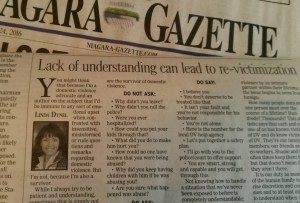 This article originally appeared in the January 24, 2016 edition of The Niagara Gazette.

 Linda Dynel