“Surviving…Thriving: A Journey of Healing Through Art” Castellani Art Museum, October 27, 2016

Standard

Music played softly in the gallery and advocates from local help agencies answered questions and offered information and guidance at tables set up in the lobby as students, faculty and members of the surrounding community viewed about 80 pieces of art created by survivors of domestic violence in a special exhibit at Niagara University’s Castellani Art Museum.

“This is the first year Niagara University has been part of the event. NU students have created a red flag – part of the national Red Flag Campaign, which addresses the red flags of dating violence, said Karrie Gebhardt, director of domestic violence and parenting services at Family and Children’s Services of Niagara. The initiative is a campaign to remind people to ‘say something’ if they see the signs of dating violence in a friend’s relationship. Some of the red flags include, coercion, jealousy, stalking, emotional abuse, sexual assault, isolation and victim blaming.

Eileen Wrobel, a Niagara Falls Police domestic violence victim advocate, facilitated the art exhibit with survivors through the Windows Between the Worlds art program.” – Nancy Fisher, Buffalo News, October 20, 2016

20161027_165301

“No matter what anyone says or how they try and justify the behavior, it is not O.K. to be treated poorly by anyone. Especially when they call it love.”

20161027_165616

This is the piece that brought me to tears; even now, it’s hard for me to look at.

20161027_165504

“If I can say anything to convince you to leave before it’s too late, (I’d say) ‘It’s not worth it and there is better love.’ I am a survivor by the grace of God.”

20161027_165955

I had a student ask me at a recent event if her friend (who is being battered, but who is also struggling with immigration issues) would be arrested and/or deported if she reached out to authorities for help. The above piece perfectly illustrates this often times overlooked issue.

20161027_165846

Oil on canvas

20161027_165712

The Silent Witness Project is a traveling project created in 2016 by high school senior Andrew Villella as his Eagle Scout Project. It is a reconstruction of the original life-sized project built in 2006 when there were only nine victims. Each figure represents an individual who once lived in Niagara County whose life was ended violently at the hands of a spouse, former spouse or intimate partner.

20161027_170006

More than 200 students attended this eye-opening event

20161027_170031

Dr. Dana Radatz, Criminology professor at Niagara University, was instrumental in bringing this event to fruition.

20161027_170123

The YWCA, The Child Advocacy Center of Niagara and Niagara University’s Counseling Center were among the community and campus based help centers who donated their time in order to offer information and guidance to those in attendance.

20161027_165048

A big “Thank You” to Karrie Gebhardt for graciously sharing the Family & Children’s Services table so that Leaving Dorian might be displayed.

Patriarchal Terrorism

Standard

patterrI like words. Well, yeah… I write, so…you’d think. But not just any words; I like the right words. I like words (and phrases) that make you perk up and take notice. More specifically, I like descriptors that are so narrow, so specific, that when you read them you think, “Yes! That’s it! That’s exactly the right way to phrase that!”

I first saw the words “Patriarchal Terrorism” a couple of weeks ago; I was reading a paper written in the mid-nineties by Michael P. Johnson. Immediately upon seeing those two words pushed together on the page, I literally got up, went my computer and started Googling the phrase to see what other articles and information might be associated with it.

Terrorism. It’s a word that’s all too common in our post 9/11 world, but in 1995, “Terrorism” wasn’t a word that was thrown around lightly. It wasn’t a part of our daily vernacular. And yet here was this paper written twenty years ago, using it in regard to domestic violence. The paper was published a month before my older daughter was born, just a few short months before my ex-husband put his hands on me for the first time, nearly killing me.

“Patriarchal terrorism, a product of patriarchal traditions of men’s right to control ‘their’ women, is a form of terroristic control of wives by their husbands that involves the systematic use of not only violence, but economic subordination, threats, isolation and other control tactics….The terminology ‘battered wife’ is objectionable on the grounds that it shifts the focus to the victim, seeming to imply that the pattern in question adheres to the woman rather than to the man who is in fact behaviorally and morally responsible (sic) The term ‘patriarchal terrorism’ has the advantage of keeping the focus on the perpetrator and of keeping our attention on the systematic, intentional nature of this form of violence.”*

Patriarchal Terrorism. Yes, those are just the right words to describe what I lived through. That is domestic violence.

*Excerpted from “Patriarchal Terrorism and Common Couple Violence: Two Forms of Violence Against Women” by Michael P. Johnson, Journal of Marriage and Family, Vol. 57, No.2, (May 1995),283-294

Rule Of Thumb

Standard

20160421_083439Did you know that the phrase “rule of thumb”is actually derived from British Common Law codified by Sir William Blackstone in 1768?
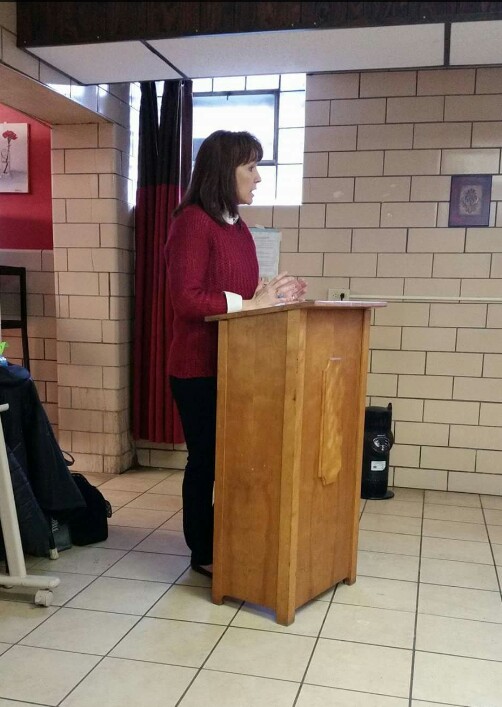
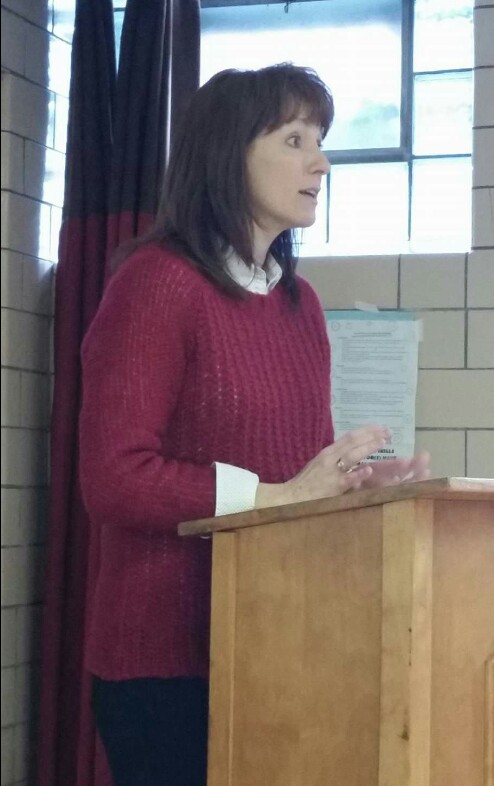
“While Blackstone never attempted to criminalize battering, he did create the first effort to regulate the severity of allowable battering. He codified the ‘rule of thumb’ stating that a husband had the legal right and responsibility to control and punish his wife. However, that punishment was to be done with a stick no bigger than the husband’s thumb.”*

We give a lot of lip service to putting an end to domestic violence, but how far have we really come in the last 250 years in what we believe is acceptable behind closed doors? To that end, how often do we reference our partner/spouse in terms of property or ownership by using possessive words like “mine”? Objectification is like a gateway drug; it feeds selfishness and ego and impedes us from seeing someone as wholly their own person, to be valued and respected aside and apart from our own needs, wants and desires.

*Excerpted from Self-Defense and Battered Women Who Kill: A New Framework , Ogle/Jacobs, 2002

Gerard Place, February 2, 2016

Standard

Presented “Beyond Leaving Dorian: A Discussion on Domestic Violence” to the women of Gerard Place, a transitional housing shelter for battered/recovering women and their children.

gp3

Domestic violence isn’t a feeling, it’s a fact; talking statistics and mortality rates from domesticabuseshelter dot org

gp1

Many women attended, though only a few agreed to be photographed. The stigma and shame attached to being a victim of DV is part of what keeps women from stepping forward and asking for help. I was happy to allow each woman her privacy, depending on her individual comfort level. Each and every woman in that room has my utmost respect and I was grateful to each for choosing to attend.

gp7

Plenty of good questions, some of which I’d never been asked before. These ladies came prepared!

gp9

The woman of Gerard Place are provided day care services so that they can attend presentations like mine as well as educational/employment/vocational training, life skills classes and counseling.

gpkaitlinprice

Kaitlin Price, Case Manager & Life Skills Coordinator, who put our afternoon together. Bright, organized and always ready with a smile, Kaitlin’s positive attitude is infectious.

gplogo

Gerard Place first opened its doors in 2000, the culmination of the work of 12 congregations of Women Religious in the Diocese of Buffalo who created and sponsored the agency on the grounds of the former St. Gerard Parish. Located in the heart of one of Buffalo’s poorest communities (the Bailey-Delevan neighborhood, where the unemployment rate is a staggering 55% among those aged 19-39 and 40% of children live below the poverty line) Gerard Place has assisted hundreds of families by giving them the tools that they need to help themselves and break the poverty cycle.

In 2009, the Junior League of Buffalo/Buffalo News Education Building was opened, providing GED and computer classes, job readiness training, like skills support and health and nutrition education to both families in residence at Gerard Place as well as the community at large.  In any given year, nearly 40 different collaborative partners utilize the facility and share their expertise with those in need. Four years later, in 2013, agency leadership announced a campaign to renovate the former St. Gerard Parish Hall building and turn it into a multi-purpose community center.  The result of this ambitious project will be a vocational training program (coordinated by partner Allied Health), a gymnasium, an expanded computer lab and day care center, an additional wing of classrooms and an industrial kitchen.

Residents are not given a “hand out,” they are earning a “hand up.”

Please visit   http://www.gerardplace.org   for information on the many fundraising opportunities that you can take part in to support Gerard Place.

**Information on Gerard Place was excerpted from their website.


Family & Children’s Services of Niagara, January 21, 2016

Standard

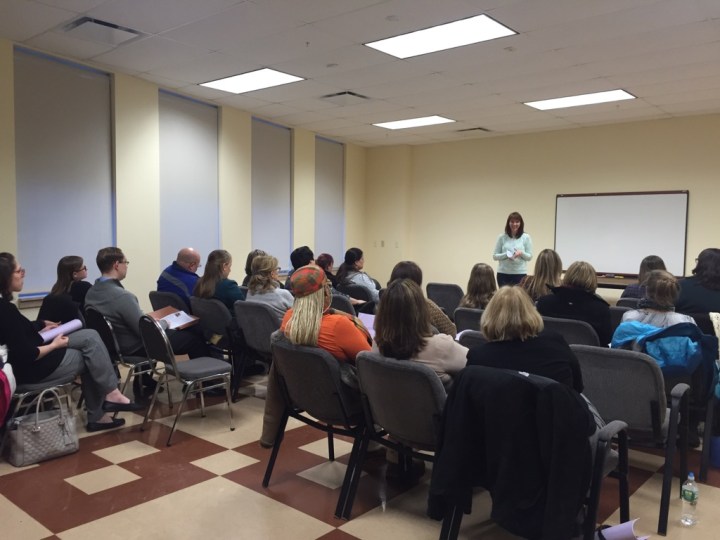
Presented “Beyond Leaving Dorian: A Discussion on Domestic Violence” to staff and advocates from Family & Children’s Services of Niagara, Legal Aid, Niagara County Sheriff Department, YWCA of Lockport, Dr. Dana Radatz from Niagara University and NU interns.

FACS5

Seeing the group from this perspective really doesn’t do them justice. They look incredibly average; they could be your next-door neighbor or your co-worker. And they have vague, vanilla sounding job titles like “Child Advocate” and “Coordinator”. What you can’t see are their capes; the “S” on their chests are invisible. These dedicated women and men are truly some of the super-heroes of our community.

FACSSTAFF3

Larissa, Advocacy Coordinator (in black) kept everything running smoothly.

FACSSTAFF4

Nellie (in teal) with the YWCA of Lockport.

FACS1

Talking about how quickly Leaving Dorian had to be taken from ebook to paperback – two months from the initial publication date!

Excerpted from the Family & Children’s Services website:

“2015 marked the 120th anniversary of Family & Children’s Service of Niagara. Founded in 1895, Family & Children’s Service of Niagara has met the ever-changing needs of our community for more than a century by providing the residents of the Niagara region with a wide range of community and social work services. Over the years our name has changed and our services have been modified to meet the needs of the community in the 21st century, but our work of helping people help themselves has remained. Thousands of children, adults and families have turned to the agency for compassionate, affordable and professional help to meet their needs. Family & Children’s Service is truly a family service agency providing a mosaic of inter-related services for the benefit of the entire family from infants to adults.”

These services include, but are not limited to:

  • Domestic Violence Services, including Passage House Emergency Shelter
  • Parent Empowerment Program
  • Healthy Families Program
  • Youth Services, including Casey House (runaway & homeless youth shelter) and The CRIB Maternity Group Home (for pregnant and parenting teens)
  • Mental Health Counseling for adults and children

24/7 DV Hotline: 716-299-0909      *****      24/7 Runaway Youth Hotline: 716-285-7125


Project Runway December, 2015

projectrunway

Staff of Project Runway (…a drug and alcohol-free pathway for young women) and related departments at Niagara Falls Memorial Hospital gathered to be a part of the seminar, “Beyond Leaving Dorian: A Discussion on Domestic Violence”. A big thank you to Sarah Obot, Community Outreach Coordinator with Project Runway for inviting me and for organizing this gathering of such intelligent, kind, highly motivated women!


Lack of Understanding Can Lead To Re-Victimization

Standard

20160126_113025~2This article originally appeared in the January 24, 2016 edition of The Niagara Gazette.
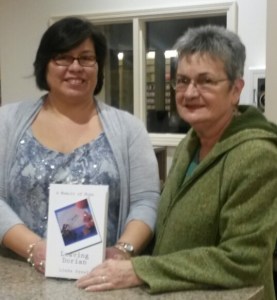
“You might think that because I’m a domestic violence advocate and an author on the subject that I’d be immune to any sort of emotional upset when confronted with insensitive, misinformed or rude questions and remarks regarding DV. But I’m not, because I’m also a survivor. While I always try to be patient and understanding, sometimes that is simply not enough. As I am on the heels of one particularly taxing interaction, I thought it might be helpful to offer a primer of sorts for anyone who may find themselves in the company of someone who has summoned the courage to confide that they are being battered or are the survivor of DV.

Do not ask:

  • Why didn’t you leave?
  • Why didn’t you call the police?
  • Were you ever hospitalized?
  • How could you put your kids through that?
  • What did you do to make him hurt you?
  • How could no one have known that you were being abused?
  • Why did you keep having children with him if he was abusing you?
  • Are you sure what happened was abuse?

Do ask:

  • Is there anything I can do to help?

Do not say:

  • I’d never let someone do that to me.
  • I’d never have thought that of him; he seems so nice.

Do say:

  • I believe you.
  • You don’t deserve to be treated like that.
  • It isn’t your fault and you’re not responsible for his behavior.
  • You’re not alone.
  • Here is the number for the local DV help agency.
  • Let’s put together a safety plan.
  • I’ll go with you to the police/court to offer support.
  • You are smart, strong and capable and you will get through this.

Not knowing how to handle a situation that we’ve never been exposed to before is completely understandable; many people might say that they’ve never been exposed to DV or known anyone who’s been affected by it, either. But if we consider the statistic from nadv.org that one in three women (and one in four men) will experience some form of physical violence by an intimate partner within their lifetime, the issue begins to seem less foreign. How many people does any one person meet over the course of a lifetime? Hundreds? Thousands? This statistic says that each and every one of us has known victims of DV and do know victims of DV. They’re our family members; our friends and our co-workers. Shame and fear often times keep them hidden, but that doesn’t mean that they aren’t there.

It is our duty as members of the human family to exercise discretion and compassion and to at least attempt to understand when we are told that someone close to us is being battered. The reality is that a victim’s life may depend on it.”

“16 Days of Activism”

Standard

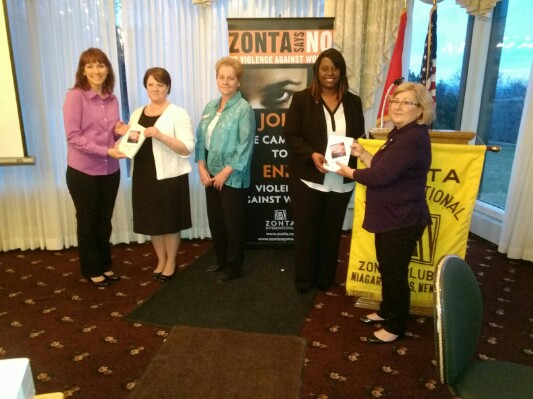
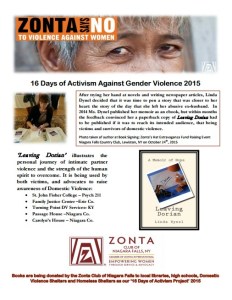
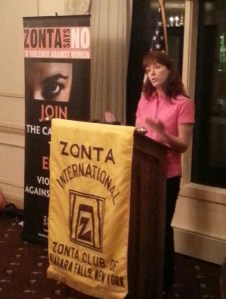
Zontians from the Niagara Falls, NY club gifted copies of Leaving Dorian to select help centers, schools and libraries in Niagara County as a part of Zonta’s 2015 Domestic Violence Initiative “Zonta Says NO! to Violence Against Women – 16 Days of Activism”.

Screenshot_2015-12-11-17-00-29

Zontian Angie Henderson delivers a copy of Leaving Dorian 

karriedonation

Chapter President Gretchen Leffler and member Dr. Lindsay Edwards presented multiple copies to member Karrie Gebhardt, Director of Passage House, an emergency shelter for battered women and their children sponsored by Child & Family Services of Niagara. The books will be used for staff development as well as for residents of the shelter to read.


CathyProjMagdalene

Cathy is a volunteer with The Magdalene Project, an outreach to women mired in sex trafficking in the City of Niagara Falls. Volunteers from The Project go out at a night a couple of times a month and give these women Ziploc bags full of personal care items like shampoo, toothpaste, etc. as well as information on how to escape the grip of prostitution. The Magdalene Project is located on Falls Street in Niagara Falls.


JPotterNFLibrary

Zontian Daisy Waters with Jennifer Potter, Acting Director of the Niagara Falls Public Library. Ms. Potter explained that the library has become a “safe space” of sorts; there have been times that women have stayed inside the building until the person they were afraid of had left the premises, and library staff has been asked on more than one occasion to call the police on behalf of a woman who felt threatened.


jsusanbencarolynshouse

J. Susan Ben, Director of Carolyn’s House (transitional housing for homeless women and their children) receives books from Zontian Maggie Pollock.

nfrepswithbooks

Andrea Fortin-Nossavage, Niagara Falls High School history teacher and Ebone Rose Bradberry, Coordinator of the Niagara Falls Community Schools Initiative Program, receive books for their staff and students.

nwhs

Dr. Kyle Patterson, Zonta Club of Niagara Falls VP; Lisa Lidamer, Niagara Wheatfield High School Guidance Counselor; Paul Gaigavich, NWHS Assistant Principal; Timothy Carter, NWHS Principal and Zonta Club President Gretchen Leffler.


lewport

Donation to Lew-Port High School! This wonderful, caring staff was full of great ideas on addressing DV and Teen Dating Violence with students and staff for the upcoming 2016-2017 school year! From left to right: Trina DiVincenzo, Guidance Counselor; Gretchen Leffler, President Zonta Club of Niagara Falls; Terri Faut, Librarian; Kelly Ulrich, Health Teacher; Andrew Auer, Principal.

govjoanneraymond

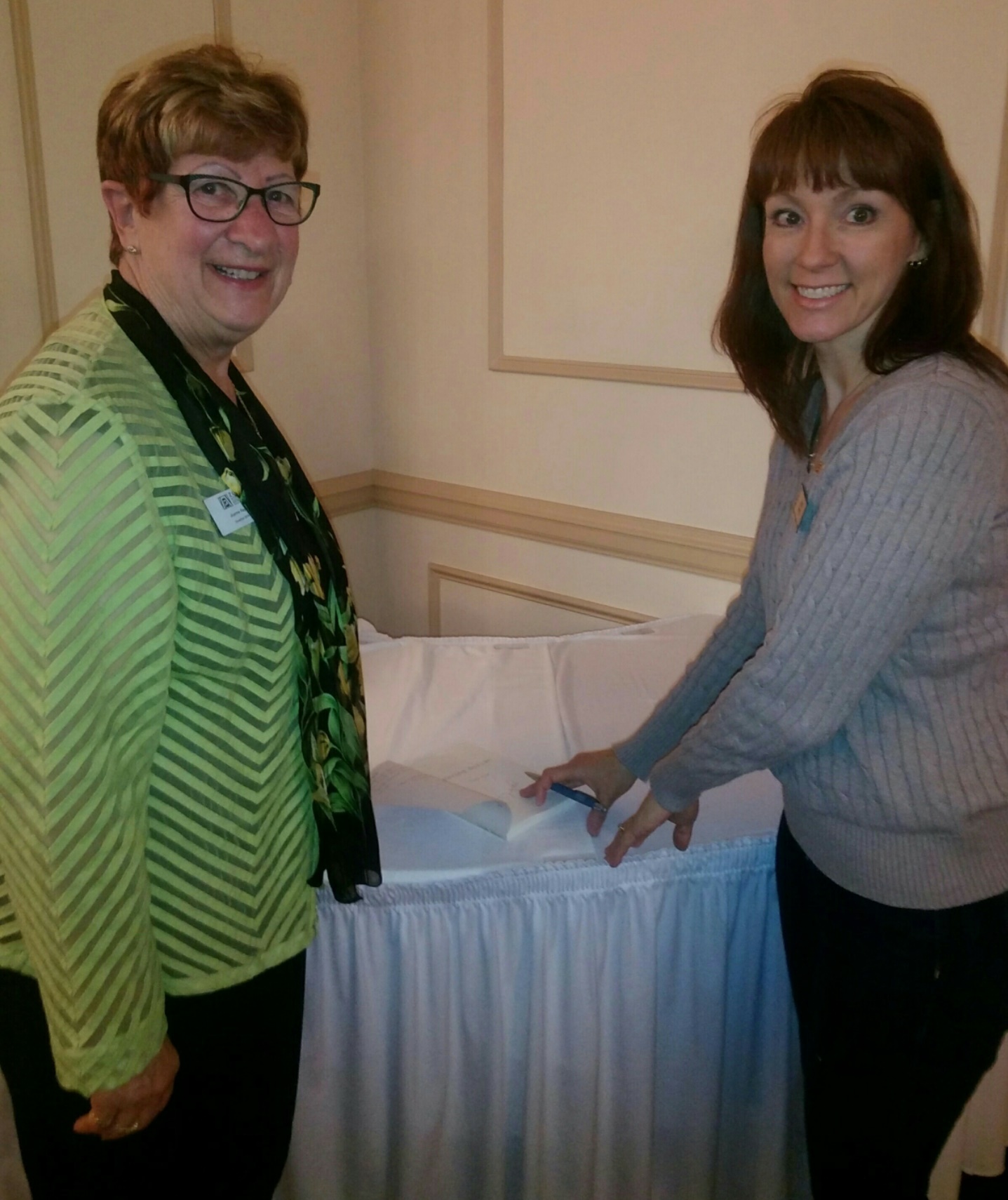
Signing a copy of Leaving Dorian for Zonta’s District 4 Governor Joanne Raymond. Joanne will be traveling to Nice, France, in July for Zonta International’s 63rd Convention and will be taking a copy of the Niagara Falls, NY 2015-16 Service and Advocacy Report with her. She told members at the May meeting that, “…no other club has done what you’re doing..”. I’m over the moon that Leaving Dorian was able to play such a large part in that advocacy effort.I’m tremendously excited that Joanne will be sharing her thoughts on Leaving Dorian with other Zonta members, Presidents and Governors from all over the world. I’m truly blessed to have so many amazing women supporting my work and advocacy efforts. God Bless the women of Zonta, here in the US and all over the world.


Screenshot_2015-11-30-14-47-32

I’m not sure how I thought I was going to feel when I finally saw this in writing, but what I do feel is humbled, honored, and a little bit relieved. I wrote Leaving Dorian because I wanted to make sure that my own awful experience wasn’t all for nothing. My hope was that someone, somewhere, might read it and think, “Oh, I’m not all alone? I’m not to blame for this awful thing that’s happening to me? Maybe I can get help, leave and start my life over again. Maybe there is hope, after all.”

My goal was one woman. Just one. I thought that if just one woman was to be able to see beyond the hell that she was living in – believe that she could save herself – well, then, I’d have achieved my goal.


Zonta Club of Niagara Falls, New York, October 14, 2015

zontaoct14

October is Domestic Violence Awareness Month, and I was honored that the ladies of Zonta asked me to come and speak about writing Leaving Dorian as well as my own experience with domestic violence.


Ready

Standard

ribbonI receive dozens of posts on my Facebook feed every day from a variety of different domestic violence help centers, each working in their own way to support victims and survivors. I also receive invitations to fundraisers in support of shelters and notifications on legislation that will help (and unfortunately, sometimes hurt) victims and their families. And of course, mixed in with all of that, I also receive plenty of little inspirational quotes. I usually don’t mind them; they’re typically paired with a lovely picture and it can be refreshing to be inundated with that sort of positivity after hours spent staring at my computer screen. Some are silly, but most are uplifting and so profound in their simplicity that I wonder why I didn’t think of them myself. There would have been no need to write a whole book if I could only have pared my message down to eight or ten beautifully written and impactful words! Yet every once in a while I’ll see one that gives me pause; I’ll sit and stare at it and think, “Why would the person who posted this have thought that it was appropriate for their page?” since, generally speaking, the pages in question are usually meant to be read by victims and survivors of DV.

That’s what happened yesterday; a post came through that was attributed to Hugh Laurie. It read, “It’s a terrible thing, I think, in life to wait until you’re ready. I have this feeling now that actually no one is ever ready to do anything. There is almost no such thing as ready. There is only now. And you may as well do it now. Generally speaking, now is as good a time as any.” At first glance I thought, “Well, sure,” and kept scrolling. But then I thought, “Wait a minute; what?” I scrolled back and re-read it and began to wonder: is that really the message we should be sending to women who are living with DV?

Ready. On its surface and to anyone who’s never lived with DV, ready seems like a non-starter. Of course a victim should be ready; why would anyone stay in a relationship riddled with physical and/or emotional abuse? To an outsider, it seems like being ready should come as naturally as breathing. Unfortunately, that’s not the case. Unless a victim is ready – mentally, emotionally, spiritually, and psychologically – they run the risk of succumbing to the myriad of emotional obstacles that naturally occur in the tumultuous separation process and can run the risk of returning to their abuser.

Being ready is also essential because that is where a victim’s power lies. There is control and strength and conviction in being ready. A victim who is ready is willing to do whatever they have to in order to get out safely and to stay gone. Being ready also fortifies them to have the courage to do what no victim ever wants to: they will Tell – family, friends and co-workers. They will open their life to outsiders like lawyers and police officers and social workers. They will bare their shame and guilt and all of their confused feelings and emotions and run the risk of being judged because they have decided that the risk of embarrassment and the judgment of others is not as bad as staying with their abuser for one more day.

A victim who is ready understands that in order to achieve freedom they need to stay safe. A victim who is ready also understands that there is safety in Change. A victim who is ready has the strength to completely change their day to day routines in order to keep themselves safe, everything from modifying their work schedule to temporarily eliminating social media from their lives. They will trade in a car that they love in order to drive one that is unrecognizable to their abuser. A victim who is ready to leave and to stay gone is willing to live in a shelter, temporarily receive public assistance if necessary and to accept the kindness of strangers because they know that they cannot do it alone. Pride nods to ready.

I know from my own experience that until I was ready, nothing and no one could have gotten me to leave my abusive ex-husband. My family and friends could have knocked down my front door and dragged me out and I would have pulled back just as hard in the opposite direction. I wasn’t physically shackled; I could have literally walked out the front door at any moment. But I was held mentally. I was held emotionally. I was held spiritually and psychologically and until I was ready to break those invisible bonds, no one could have done or said anything to free me. And yes, I could have been killed; I understand that now and I knew it then but even knowing that I was in mortal danger every day wasn’t enough to get me to leave, because I wasn’t ready

We all want what’s best for the people that we love. If we know or suspect that a family member, friend or co-worker is living in a dangerous situation, of course we want them to be ready to get themselves to safety. All that we can reasonably do, though, is to love and encourage them. We can listen and be there as a sounding board. We can even offer to help them find an agency that is staffed with trained professionals who can guide them through the process of putting together a safety plan. We can let them know that we’ll be there for them if and when they decide to leave. Letting loved ones know that we see their struggles and support them without judgment might just be what a desperate victim needs to flip that internal switch and decide that they’re finally ready after all.

**A much less succinct version of this was my very first blog entry, posted way back in March of 2014.

Grandma Zella and The Light

Standard

20150424_074011~2~2This is my paternal grandmother, Zella Bardwell. I didn’t know her when I was growing up; I’d only visited our family’s dairy farm a couple of times when I was a very little girl and once my parents divorced my father and his family became little more than distant memories. It took twenty-five years, but after an excruciating divorce of my own I decided that what I needed most in order to rebuild my life and have a successful future was to reconnect with my dad and his family. After a joyful and long overdue reunion with my dad, I called my grandma. I’ll never forget that call. I was sitting on the edge of my brother’s queen-sized bed that I was sharing with my two small daughters. The room was piled high with all of our personal belongings and all of my brother’s things, too. He’d been gracious enough to not only let us stay with him after I finally decided to escape my abusive marriage, but he’d also given up his bed and most of his personal space in order to accommodate us until I got on my feet. I sat there among the piles and listened to my grandma tell me about my family. She talked about the farm and my grandpa who’d long since passed. She told me her memories of my childhood (the little she’d known) and my dad’s childhood and her own. We talked for two hours. I didn’t know it at the time, but every conversation for the next thirteen years would be just like that one.

Grandma talked. She gave me history and perspective. She told me things I’d never known and confirmed suspicions about myself that I’d always harbored. My mother’s family had raised me; they’d loved me and cared for me and sacrificed for me, but there had always been an odd disconnect. It was more than the fact that I didn’t look like them, though perusing family photos it was clear that I was odd man out. I just didn’t ever seem to “fit”; they didn’t ever really seem to “get me”, nor did I “get them”. But with Grandma Zella, it was effortless; I was hers and she was mine and for thirteen years she was the one person that I knew I could truly depend on to understand what I was going through. She’d raised six kids on a farm that for many years had no indoor plumbing or central heat. She’d supported my grandfather’s desire to work constantly and ferociously, working by his side not only on the farm but also at the family’s grocery store. She understood poverty, loneliness, fear and doubt. I could tell her anything and she always seemed to get it.

She was the one person I didn’t have to censor myself with, but she was also the one person who would tell me the unabashed truth, as she saw it, no matter what. She was an absolute beacon in my life when my five kids were little and my husband and I were struggling with a new marriage, a new business and trying to blend our two families into one. She helped me work out my concern and disappointment when my husband spent the majority of his time either at work or doing his own thing, and assured me that I wasn’t the worst mother in the world when I was struggling with one or more of the kids. She taught me how to administer tough love, how to disagree without being “judgy”, and that the best way to avoid putting your foot in your mouth was to keep your mouth closed! She taught me that being able to laugh at myself would help to keep me sane in the midst of our constant and very normal family drama. Most importantly, she taught by example; grace, dignity, understanding and patience were all lessons I learned over the phone. We were a whole state apart and because I had five little ones and a growing business and funds were always tight, I only physically saw her three times in those thirteen years. Her voice was all I had.

In February of 2013 we were on a short trip for my birthday with our two youngest children when I got a phone call from one of my sisters; both my dad and my gram had been rushed to the hospital overnight. I’d known that my dad had been sick and his hospital trip wasn’t all that out of the ordinary, but I hadn’t known grandma had been sick. I mean, sure, she was ninety-one and had been living in a nursing home for almost a year, but rushing-to-the-hospital-sick? I hadn’t been prepared for that.

Though my sister assured me that there was no need to cut my vacation short, within twenty-four hours both of their conditions had worsened to the point that we were preparing to leave; my husband would take the kids home and back to school and I would drive across the state and tend to my precious family. Then as we were packing my phone rang; it was my dad. My dad?! Yep; he was feeling better and assured me that while gram had gone through a bit of a struggle, her doctors were talking about transferring her back to the nursing home. Crisis averted. I couldn’t have been more relieved. Other than my husband and children, my dad and my gram were my family. They were my heart, and I truly couldn’t imagine my life without them in it.

A week or so later the phone rang. It was, of course, my grandma. My dad had said that the nurses were trying to keep her quiet so I hadn’t called to check on her yet, but she wanted to talk to her granddaughter and no one (not even a staff of very patient and well-intended nurses) was going to stop her. She had something important to tell me.

In her always gracious grandma way she apologized for not sending me a birthday card; it was the first time she’d missed my birthday in thirteen years.

“Do you know what I was doing on your birthday?” she asked. I told her no, I didn’t; she had been ill and hospitalized, so I couldn’t figure out what she was trying to get at.

“I was dying,” was her quick response.

She went on to tell me that she’d died in her hospital room. That though she was aware that the nurses were trying to revive her, she’d allowed herself to slip away; to be pulled toward a light. She said that she went through a tunnel and that at the end of the tunnel the light was very bright. She said that she knew that the light was God and that she was very afraid, because she knew that He knew all of the “bad” things that she’d done in her life. She said that she felt sorry and that He knew that without her having to say anything at all. But then He showed her all of the good things that she’d done in her life and asked her if she was ready to come home.

It is important to note that when my grandma hit her mid-eighties, she started to feel mildly depressed. She would often state that she felt “useless” and wondered why God continued to let her live when she was so ready to die. She was tired. There was no more farm to work and no more grocery store to run and her kids and grandkids and even great-grandkids were all grown and gone and didn’t need her anymore. She had done her job and done it well and she knew it. Gram was ready to go; not in a morbid, death-wish kind of way, but more of an impatient, I’m-waiting-on-a-bus-that-never-seems-to-get-here kind of way. She was joyfully ready. Impatiently, joyfully ready. I, however, didn’t share in her readiness. I told her time and again that she wasn’t useless. I told her that I needed her here and that she needed to stick around. Who would I talk to? Tell my secrets to? Who would kick me in the butt when I needed kickin’? Now here she was telling me that she’d died, and the reality of all of her ninety-one years gripped at my heart like a vice.

“I thought about it, but then I said ‘no’. God asked me why; that I’d been asking for years and years to come home and now I didn’t want to? I said I did want to, just not that day. I told him, ‘I can’t go today because today is Linda’s birthday. If I go today, it will ruin her birthday for the rest of her life and I can’t do that to her’.”

Tears streamed down my face as I tried to catch my breath.

“So, He said, ‘Alright, Zella, you can go back. But the next time I call you, you’ve got to come, O.K?’ I said, ‘O.K.’.” She paused. A long, thoughtful pause. “So when my time comes, you have to be O.K. with it, too, alright, Linda?”

I tearfully agreed. It was the one and only time I ever lied to my grandma. Four months later she died peacefully in her sleep.

Of all of the lessons my grandma taught me, this was the greatest. My grandma loved me. Not some vague, biologically-driven obligatory love. She loved me. We throw the word love around like it’s nothing. We use it to get what we want and to secure our futures and to move the people around us. But real love, soul-love, doesn’t work for the benefit of the individual, it works for the benefit of the other. How many times has the phrase “I’d die for you” been uttered? Would you? Would you really die for another person? Maybe. But here’s a bigger question: Would you live for someone when all you’ve wanted was to be done?

My grandma had prayed for a solid decade for the sweet relief of death, to be reunited with my grandpa and her son who had died long before her and her own mother and father and brothers. My grandma wanted nothing more than to move on and told me the same every chance she got. Yet when the time came and she was no more than a breath away from the finish line, she paused and thought about me.

The next time you tell someone you love them, think about what that really means. Do you love them? Really? Would you put them first? Would you make yourself uncomfortable so they could be at ease? Would you sacrifice the one thing you desperately wanted in order to give them the gift of peace? And could you do that without an ounce of bitterness in your heart and truly expect nothing back in return?

Love is a big word; use it wisely.