Zontians from the Niagara Falls, NY club gifted copies of Leaving Dorian to select help centers, schools and libraries in Niagara County as a part of Zonta’s 2015 Domestic Violence Initiative “Zonta Says NO! to Violence Against Women – 16 Days of Activism”.
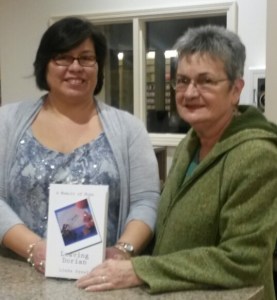
Zontian Angie Henderson delivers a copy of Leaving Dorian

Chapter President Gretchen Leffler and member Dr. Lindsay Edwards presented multiple copies to member Karrie Gebhardt, Director of Passage House, an emergency shelter for battered women and their children sponsored by Child & Family Services of Niagara. The books will be used for staff development as well as for residents of the shelter to read.

Cathy is a volunteer with The Magdalene Project, an outreach to women mired in sex trafficking in the City of Niagara Falls. Volunteers from The Project go out at a night a couple of times a month and give these women Ziploc bags full of personal care items like shampoo, toothpaste, etc. as well as information on how to escape the grip of prostitution. The Magdalene Project is located on Falls Street in Niagara Falls.

Zontian Daisy Waters with Jennifer Potter, Acting Director of the Niagara Falls Public Library. Ms. Potter explained that the library has become a “safe space” of sorts; there have been times that women have stayed inside the building until the person they were afraid of had left the premises, and library staff has been asked on more than one occasion to call the police on behalf of a woman who felt threatened.

J. Susan Ben, Director of Carolyn’s House (transitional housing for homeless women and their children) receives books from Zontian Maggie Pollock.
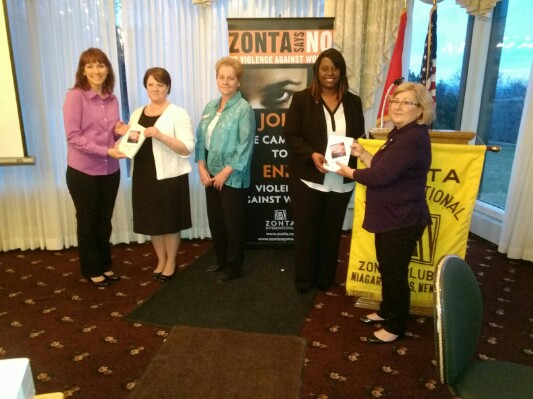
Andrea Fortin-Nossavage, Niagara Falls High School history teacher and Ebone Rose Bradberry, Coordinator of the Niagara Falls Community Schools Initiative Program, receive books for their staff and students.

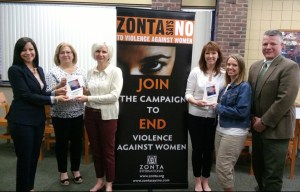
Dr. Kyle Patterson, Zonta Club of Niagara Falls VP; Lisa Lidamer, Niagara Wheatfield High School Guidance Counselor; Paul Gaigavich, NWHS Assistant Principal; Timothy Carter, NWHS Principal and Zonta Club President Gretchen Leffler.
Donation to Lew-Port High School! This wonderful, caring staff was full of great ideas on addressing DV and Teen Dating Violence with students and staff for the upcoming 2016-2017 school year! From left to right: Trina DiVincenzo, Guidance Counselor; Gretchen Leffler, President Zonta Club of Niagara Falls; Terri Faut, Librarian; Kelly Ulrich, Health Teacher; Andrew Auer, Principal.
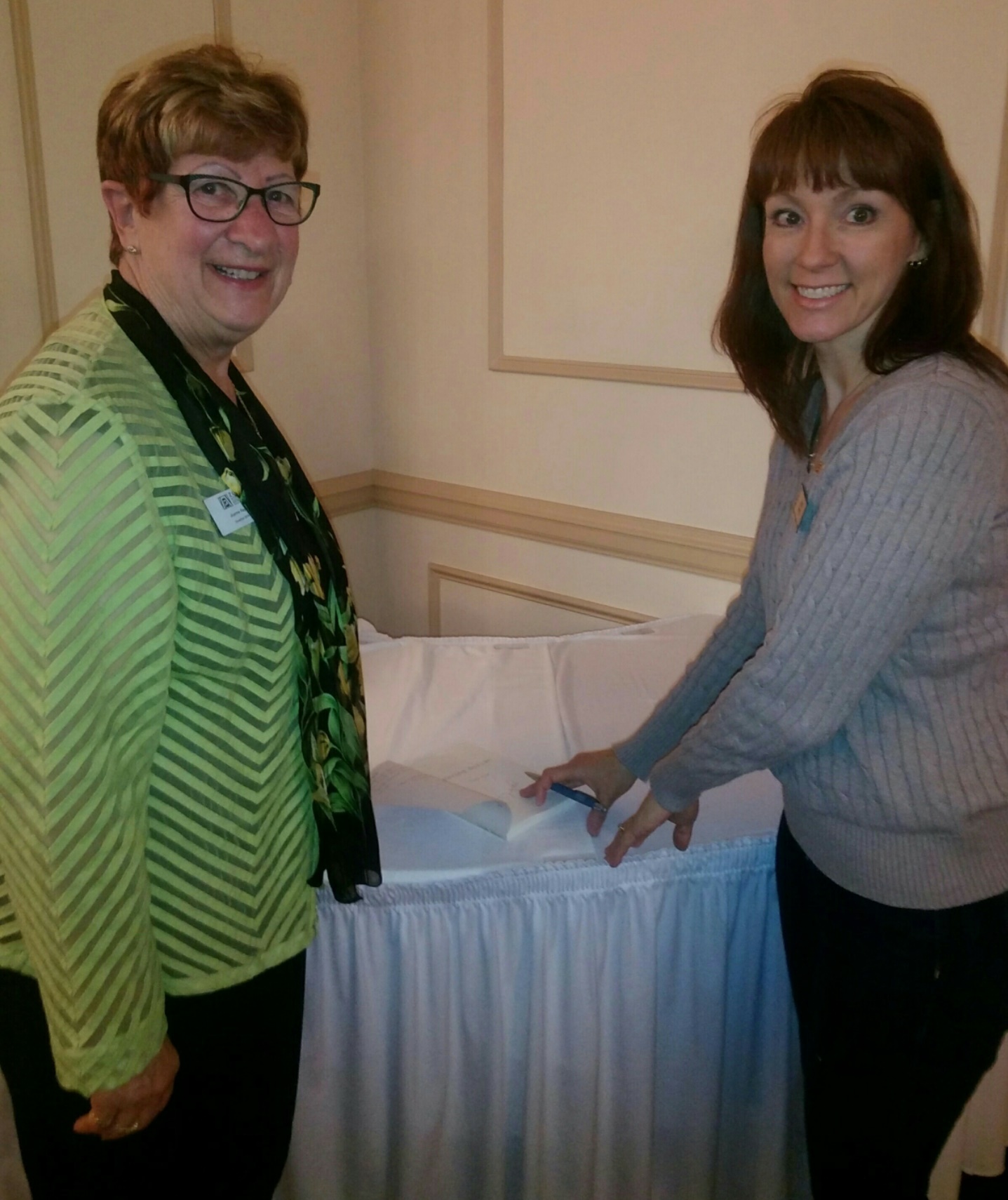
Signing a copy of Leaving Dorian for Zonta’s District 4 Governor Joanne Raymond. Joanne will be traveling to Nice, France, in July for Zonta International’s 63rd Convention and will be taking a copy of the Niagara Falls, NY 2015-16 Service and Advocacy Report with her. She told members at the May meeting that, “…no other club has done what you’re doing..”. I’m over the moon that Leaving Dorian was able to play such a large part in that advocacy effort.I’m tremendously excited that Joanne will be sharing her thoughts on Leaving Dorian with other Zonta members, Presidents and Governors from all over the world. I’m truly blessed to have so many amazing women supporting my work and advocacy efforts. God Bless the women of Zonta, here in the US and all over the world.
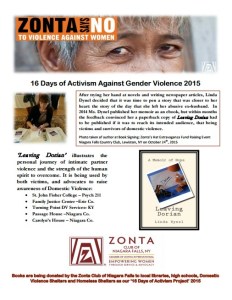
I’m not sure how I thought I was going to feel when I finally saw this in writing, but what I do feel is humbled, honored, and a little bit relieved. I wrote Leaving Dorian because I wanted to make sure that my own awful experience wasn’t all for nothing. My hope was that someone, somewhere, might read it and think, “Oh, I’m not all alone? I’m not to blame for this awful thing that’s happening to me? Maybe I can get help, leave and start my life over again. Maybe there is hope, after all.”
My goal was one woman. Just one. I thought that if just one woman was to be able to see beyond the hell that she was living in – believe that she could save herself – well, then, I’d have achieved my goal.
Zonta Club of Niagara Falls, New York, October 14, 2015
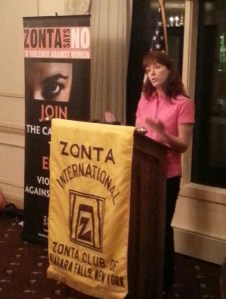
October is Domestic Violence Awareness Month, and I was honored that the ladies of Zonta asked me to come and speak about writing Leaving Dorian as well as my own experience with domestic violence.

 I receive dozens of posts on my Facebook feed every day from a variety of different domestic violence help centers, each working in their own way to support victims and survivors. I also receive invitations to fundraisers in support of shelters and notifications on legislation that will help (and unfortunately, sometimes hurt) victims and their families. And of course, mixed in with all of that, I also receive plenty of little inspirational quotes. I usually don’t mind them; they’re typically paired with a lovely picture and it can be refreshing to be inundated with that sort of positivity after hours spent staring at my computer screen. Some are silly, but most are uplifting and so profound in their simplicity that I wonder why I didn’t think of them myself. There would have been no need to write a whole book if I could only have pared my message down to eight or ten beautifully written and impactful words! Yet every once in a while I’ll see one that gives me pause; I’ll sit and stare at it and think, “Why would the person who posted this have thought that it was appropriate for their page?” since, generally speaking, the pages in question are usually meant to be read by victims and survivors of DV.

 Linda Dynel