
 I like words. Well, yeah… I write, so…you’d think. But not just any words; I like the right words. I like words (and phrases) that make you perk up and take notice. More specifically, I like descriptors that are so narrow, so specific, that when you read them you think, “Yes! That’s it! That’s exactly the right way to phrase that!”
I first saw the words “Patriarchal Terrorism” a couple of weeks ago; I was reading a paper written in the mid-nineties by Michael P. Johnson. Immediately upon seeing those two words pushed together on the page, I literally got up, went my computer and started Googling the phrase to see what other articles and information might be associated with it.
Terrorism. It’s a word that’s all too common in our post 9/11 world, but in 1995, “Terrorism” wasn’t a word that was thrown around lightly. It wasn’t a part of our daily vernacular. And yet here was this paper written twenty years ago, using it in regard to domestic violence. The paper was published a month before my older daughter was born, just a few short months before my ex-husband put his hands on me for the first time, nearly killing me.
“Patriarchal terrorism, a product of patriarchal traditions of men’s right to control ‘their’ women, is a form of terroristic control of wives by their husbands that involves the systematic use of not only violence, but economic subordination, threats, isolation and other control tactics….The terminology ‘battered wife’ is objectionable on the grounds that it shifts the focus to the victim, seeming to imply that the pattern in question adheres to the woman rather than to the man who is in fact behaviorally and morally responsible (sic) The term ‘patriarchal terrorism’ has the advantage of keeping the focus on the perpetrator and of keeping our attention on the systematic, intentional nature of this form of violence.”*
Patriarchal Terrorism. Yes, those are just the right words to describe what I lived through. That is domestic violence.
*Excerpted from “Patriarchal Terrorism and Common Couple Violence: Two Forms of Violence Against Women” by Michael P. Johnson, Journal of Marriage and Family, Vol. 57, No.2, (May 1995),283-294
 Did you know that the phrase “rule of thumb”is actually derived from British Common Law codified by Sir William Blackstone in 1768?






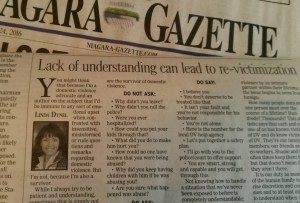 This article originally appeared in the January 24, 2016 edition of The Niagara Gazette.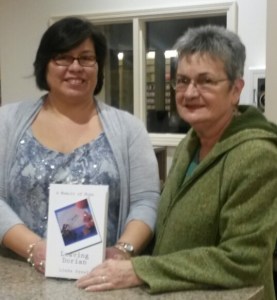




 I receive dozens of posts on my Facebook feed every day from a variety of different domestic violence help centers, each working in their own way to support victims and survivors. I also receive invitations to fundraisers in support of shelters and notifications on legislation that will help (and unfortunately, sometimes hurt) victims and their families. And of course, mixed in with all of that, I also receive plenty of little inspirational quotes. I usually don’t mind them; they’re typically paired with a lovely picture and it can be refreshing to be inundated with that sort of positivity after hours spent staring at my computer screen. Some are silly, but most are uplifting and so profound in their simplicity that I wonder why I didn’t think of them myself. There would have been no need to write a whole book if I could only have pared my message down to eight or ten beautifully written and impactful words! Yet every once in a while I’ll see one that gives me pause; I’ll sit and stare at it and think, “Why would the person who posted this have thought that it was appropriate for their page?” since, generally speaking, the pages in question are usually meant to be read by victims and survivors of DV.
 Linda Dynel