
Zoom Event – Please Join Me!
Image
 When I sat down at the computer this morning and noticed that a two star review had come through on Amazon for Leaving Dorian, I immediately assumed that a first edition copy had once again slipped through the cracks. I have disclaimers on all of my media letting readers know that if they’re given the option of purchasing a first or second edition copy, second edition is always going to be a better read. I was the newbie of all newbies when I published Leaving Dorian back in 2014 and didn’t realize the importance of hiring a professional editor. Since there’s no way to put that genie back in the bottle, I simply cross my fingers and hope that potential readers take the disclaimer to heart and purchase a second edition. But when I scrolled down to read the review, I was surprised to find that there was no mention of poor editing.
“The book is ok. A little frustrating in its organization and lacking some of the spark of other similar stories. Not totally believable.”
Now I know that the ‘organization’ the reader is referring to is my back and forth style of writing. I go from the day that I left my ex-husband in one chapter to describing my childhood and then back again. I understand how this can be confusing to some people, especially if they don’t get through the book in a couple of sittings. So, no harm no foul. The fact that the reader thought that it lacked ‘spark’, well, that’s his/her opinion and they’re entitled to that. But what made me literally laugh out loud was the last sentence: “Not totally believable.”
Whaaaaat?
Not believable?
I sat there at the keyboard, chuckling to myself. Not sure how to remedy that; it’s my actual, real and true life, so…..yeah. The reality is that I went easy on the graphic details of my childhood and my first marriage on purpose, because I vividly recall having to read an extremely graphic memoir about child abuse when I was in college. It was so horrible, so graphic, that it made my skin crawl; reading it made me cry and feel physically ill. Though it was a relatively short read, more than once I had to put it down because I felt as though the details were just too awful to know. Though I wasn’t sure just exactly what I was going to share when I sat down to write Leaving Dorian, I knew for sure that if nothing else, it had to be readable. If it wasn’t something that people could sit with then it couldn’t do its job, which was to help victims and survivors of abuse.
Again, though, readers are entitled to their opinion and if this reader didn’t believe everything that I’d written, well then, so be it; I can’t fix that. I clicked off Amazon and went on with my morning, but I couldn’t help coming back to that last line, “Not totally believable.” Why did it bother me so much?
I guess what’s bothering me has little to do with that singular review. What’s bothering me is that I know very well that victims and survivors of abuse are met every single day with that very same skepticism. Are their friends, loved ones, co-workers and neighbors coming right out and saying, “I don’t believe you”? No. But responding to a women’s candid, heart-wrenching admission that they’ve experienced something tragic with questions like, “Why didn’t you say something sooner?”, “Why didn’t you call the police?” or “Are you sure it’s abuse? I mean, couples fight; don’t make more out of this than it needs to be” is exactly the same sentiment. It’s “I don’t believe you” wrapped up in feigned moderation, excessive caution and good judgement. (…We don’t want to accuse someone unfairly, now; let’s make entirely sure we have all the facts before we start ruining reputations and upending lives…) Isn’t it interesting, though, how often it’s the abuser that’s given the benefit of the doubt instead of the victim?
Students and DV service providers have asked me on more than one occasion what I think the most important thing is that you can say to a victim or survivor of abuse. That if I only had one sentence, what would I choose? My answer is, and will always be, “I believe you”.
To continue to diminish victims and survivors with the old, worn out stories of supposed liars, “Oh, I know so-and-so whose wife lied about him hitting her and he got thrown in jail and it was total BS…” or “There was this girl when I was in college that lied about being raped and the guy she accused got kicked out of school and his life was ruined forever…” is unfair at best and harmful at worst. People lie, it’s true. And people will lie about all sorts of things, for reasons that aren’t always entirely clear. But the chances that a woman is lying when she finally steps forward to tell her story and reach out for help is incredibly slim. More often than not, victims and survivors are actually holding back; keeping the really hurtful, humiliating details to themselves. Telling just enough to get the help and services that they need in order to re-start their lives and keep their families afloat.
Maybe that reader didn’t believe my story, and that’s fine with me. But to every victim and survivor out there who reads this blog post, no worries. There are multitudes of people out there who will believe you. Reach out for help. Tell. Get to safety. Re-start your lives; you deserve nothing less.
And just for the record, “I believe you”.
 No matter how compassionate or understanding a person you think you are, at some point you’re going to be a little judge-y.
*shrug*
O.K.
Everybody scoffs. Everybody – everybody – shakes their head and screws up their mouth and (in a moment of weakness) decides that the way that someone else is choosing to conduct themselves is wrong. We look at someone’s life or their current situation or their reaction to a rough patch and think, “I would never do that!” This is especially true of domestic violence. Comments like, “I would never let a man put his hands on me!” or “I would never put my children through that!” are incredibly common.
And so … maybe that’s actually the case. Maybe you wouldn’t. Maybe your reaction would be different than someone else’s. But then again, how can you be sure? The reality is that until you’re in a given situation, you really don’t know how you’d react.
Because I work with DV victims and survivors as well as those who serve them, I was honestly of the opinion that I (mostly) understood the overall plight of the battered woman. Fortunately for me, I live in a county where the local FCS (ours is Family & Children’s Service of Niagara) offers the In Her Shoes DV Awareness Program.

Published in 2000 by the Washington State Coalition Against Domestic Violence, In Her Shoes is “…a revolutionary community education tool, designed for learning about domestic violence. Participants move, do, think and experience the lives of battered women.” Photo Courtesy of The Columbian, 2015.
I initially registered to attend because while I’ve worked with Family & Children’s Service of Niagara in the past, I was recently made aware that their Director of Passage House, Larissa Bachman, is using Leaving Dorian as a supplemental read with their interns. It got me to thinking that while I know quite a bit about FCS, I know little about the inner workings of Passage House. I thought what a great opportunity to speak candidly with Larissa and her team and as a bonus maybe do a blog post about the In Her Shoes Program.
I was completely unprepared for the experience that followed.
Participants were brought into a mixed-use room where I’d worked previously, only this time instead of rows of chairs there were long tables with stacks of colorful note cards. Each table had a sign attached: “Social Services”, “Hospital”, “Employment”, etc. Attendees were then paired up and we were told to pick a person’s name from the starter table. After that the journey begins; you are to make choices for your person while reading their perspective (as well as their batterer’s perspective) from each side of the card.
Because I’m a survivor of DV and because I work with amazing DV professionals and ridiculously intelligent and well-read professors and because I, too, have chosen to be well-read on the topic, I walked into the exercise feeling confident that I could help my person to avoid the inevitable pitfalls. There was no doubt in my mind that I would be able to guide her into a healthy lifestyle well within the hour or so time frame we’d been given to complete the exercise.
Within minutes I realized that I was wrong.
There’s no way that you can prepare yourself to be given the opportunity to make every choice from beginning to end and still “fail”. There’s no way to prepare yourself to walk through nearly forty-five minutes with a person (yes, a person written on paper, but one that you slowly and inadvertently invest yourself in) just to get to the last card and have it say “Funeral Home”.
I couldn’t believe it. Tears started to well in my eyes. I stood there trying to figure it out; why was the end result so hard to take? I mean, I thought I had it. I thought I knew. I am the “Her” in “In Her Shoes”, after all! I’ve been there. I’ve done that. And even beyond my own experience – as an author who’s made myself extremely accessible on social media – I routinely hear the most sad, perplexing and gut wrenching stories from victims and survivors alike. I thought nothing could surprise or shock me. And yet, tears.
I was seriously under the weather and probably should have stayed home that day, so I immediately wanted to blame it on that; I simply wasn’t feeling well. But the young woman that I was paired with didn’t like the ending either. I said, “Let’s go back…” So we did. Our character was young; not even eighteen. We had her go home. And yet, three cards in, she was right back in a tough spot. I suggested we go back even further, maybe right back to the second card that we read.
I was shaken. That couldn’t be her ending. I refused to finish the exercise. I simply would not walk over to the wall marker that said “Funeral Home”. There was nothing but an empty table in front of it. No more cards. It was left empty for reflection, but I didn’t want to reflect. I dried my eyes as the group sat down for debriefing.
I was happy to find out that not every story ended as tragically as ours. Other groups did manage to successfully maneuver their people into new lives. It’s worth noting, though, that at times these groups had to make choices for their person that weren’t always in line with their real-life belief systems. Again, an incredibly important lesson: You cannot impose your value system on someone else. Hard to hear? Sometimes, yes. But a necessary message? Absolutely.
Of course Ms. Bachman and her team were excellent facilitators and I’d like to believe that every attendee walked out that afternoon with all of their questions answered and with a deeper appreciation of the level of strength, courage, creativity and (sometimes) blind faith that victims routinely have to possess in order to safely and successfully re-start their lives. I know that I did. It was a humbling experience that I will carry with me; one that will necessarily be reflected in every presentation and classroom discussion that I participate in from now on.
I’m incredibly proud to be able to say that Family & Children’s Service of Niagara is my hometown service provider and that the staff there is offering unique, high-quality community education programs like In Her Shoes. Programs like these (offered in house or off-site) are exactly what HR professionals are looking for when putting together sensitivity training for Staff Development Days. Their utilization can only heighten awareness and bring about much needed change in our thought processes (and eventually, our behavior toward) victims of domestic violence.
If you are in Western New York, you can contact FCS of Niagara to schedule an In Her Shoes program experience at http://www.niagarafamily.org or by phone: (716) 285-6984
If you or someone you know is a victim of domestic violence and is need of assistance, FCS of Niagara 24/7 Emergency Hotline is: (716) 299-0909
To purchase the In Her Shoes program please contact http://www.wscadv.org
Surviving…Thriving: A Journey of Healing through Art featured nearly one hundred pieces of artwork in a variety of mediums, all created by survivors of domestic violence. It was once again held at The Castellani Art Museum (which sits in the center of Niagara University campus) in conjunction with the Red Flag Campaign, a national public awareness initiative designed to encourage college students to intervene when they see a warning sign (“red flag”) of partner violence. Niagara University, The Child Advocacy Center of Niagara, Family & Children’s Service of Niagara, The Niagara County Sheriff’s Office Victim Assistance Unit, and the YWCA of the Niagara Frontier were all proud sponsors of the event, with all proceeds being donated to Passage House Domestic Services, a program of Family & Children’s Service of Niagara.
I was happy to offer closing remarks at the Welcome Reception, as October is Domestic Violence Awareness Month.
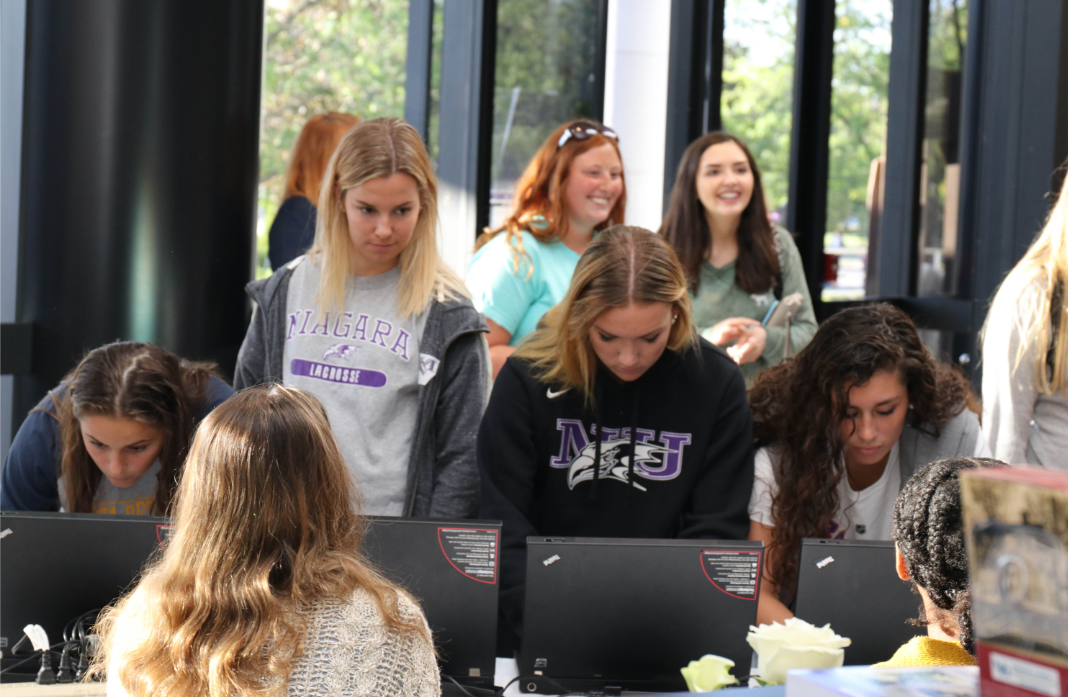
Well attended by NU students; they didn’t seem to mind waiting in line to sign in.

DV Advocates with the Niagara County Victims Assistance Unit painting pinkies 🙂 The mission of The Purple Pinkie Campaign is to eliminate dating violence. The campaign was founded in memory of 18-year-old Alex Kogut who was murdered by her boyfriend in her college dorm room at SUNY Brockport on September 29, 2012.

Students of the Niagara County Law Enforcement Academy showing off their Purple Pinkies!

It’s important to note that the event was well attended by both men and women.

Campus and community advocates made themselves available throughout the entirety of the event to address any complicated or painful emotions that attendees might experience.
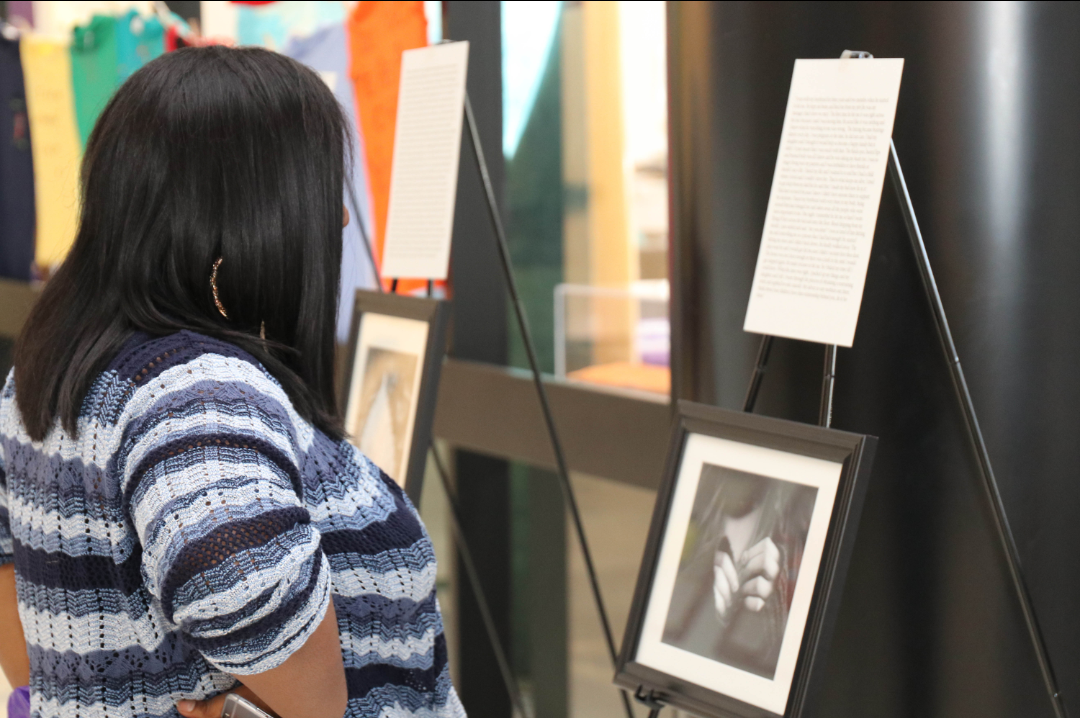
Survivor stories are featured with many of the pieces of artwork.

The Silent Witness Project was the centerpiece of the exhibit.
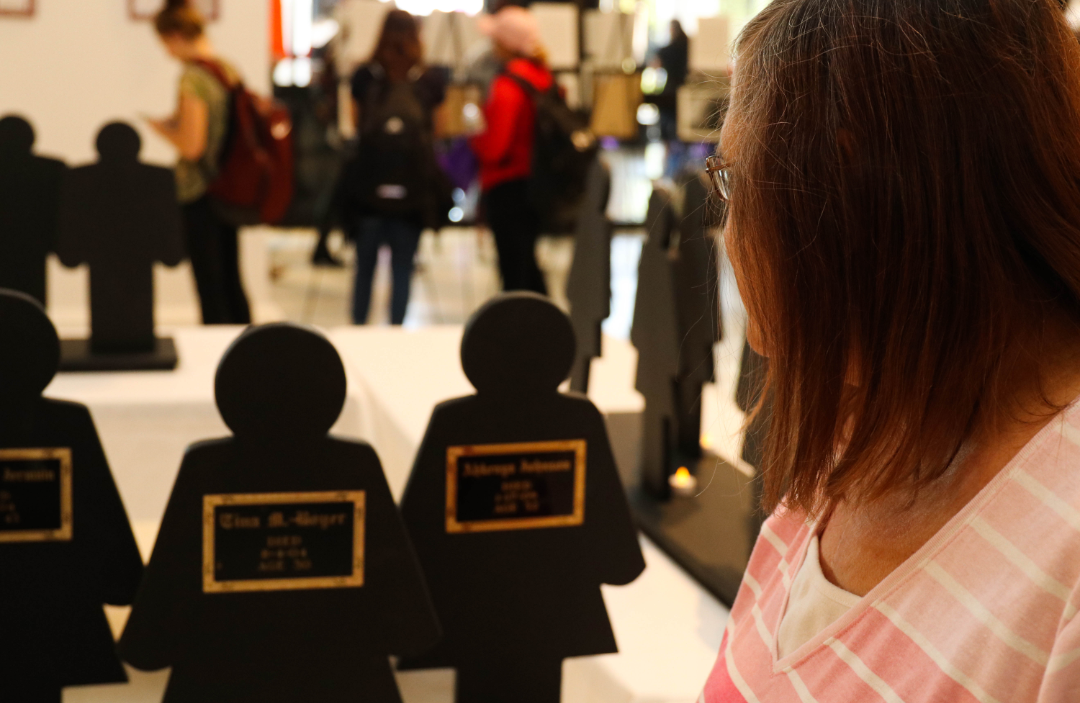
Debbie Boyer stands in front of her daughter’s Silent Witness statuette. Tina Marie was murdered in her own home by her former boyfriend on August 4, 2004.

Debbie is a pillar of strength and meeting her for the first time was truly my honor, because she’s also a fighter – In the nearly fifteen years since her daughter’s death, she’s become a well known advocate in Niagara County for her unwavering support of domestic violence prevention and response. With a deep understanding that adequate funding equals adequate services for women in need, she and her family conduct two fundraisers yearly: a cell phone drive and the “Pennies from Heaven” drive which to date has raised more than $20,000 in support of the YWCA’s DV services and programs. The YWCA of the Niagara Frontier also recently dedicated a newly renovated room in its Domestic Violence Safe Dwelling in memory of her daughter, Tina Marie.
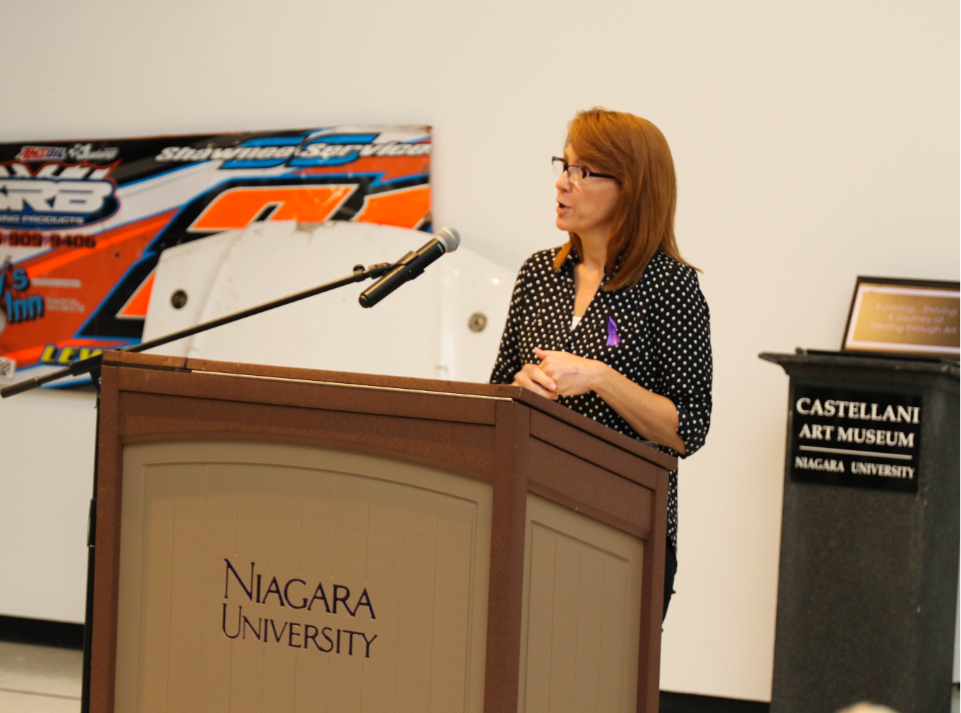
“I ask each and every one of you who will walk this floor tonight to please understand
What you’re viewing isn’t merely art, it’s strength.
It is courage and dignity and tenacity.
What these walls house tonight is a testimony to the strength of the human spirit.”
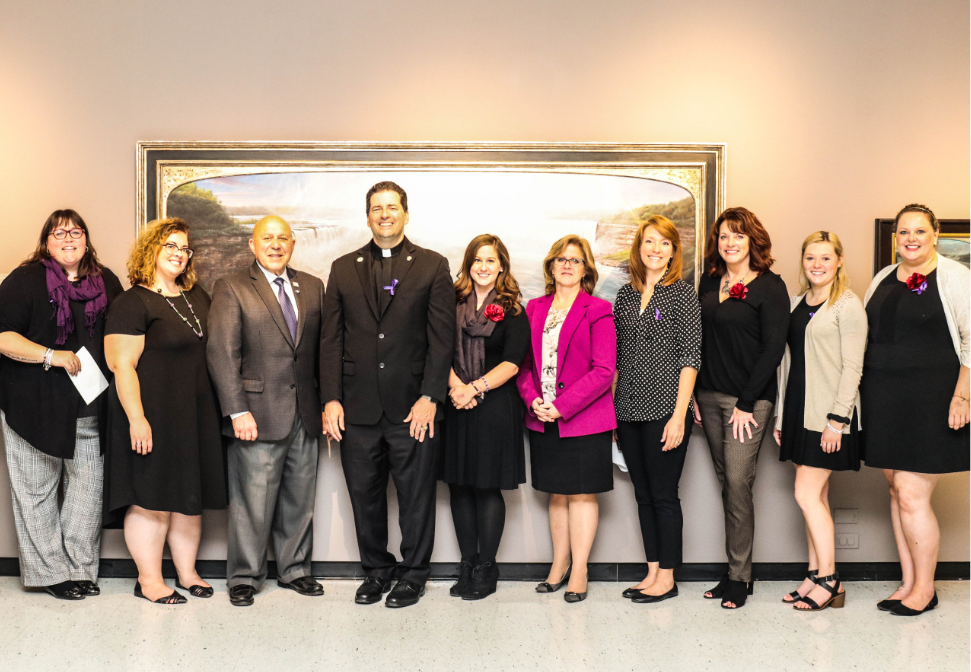
L to R: Dr. Dana Radatz, Assistant Professor of Criminology; Eileen Wrobel, Family & Children’s Services; NYS Assemblyman Angelo Morinello; Niagara University President Fr. James Maher; Larissa Bachman, Director of PASSAGE; NU Executive Vice Pres Dr. Debra Colley; *ME*; NC Victims Asst. Unit Susan LaRose; Criminology student Courtney Kenny; YWCA Sexual Violence Prevention Educator/Advocate Rachel Sandle-Sacco
Photos Courtesy of Andrew Emmons, student at Niagara University
Closing remarks at the Welcome Reception for Surviving to Thriving: A Journey of Healing Through Art at The Castellani Art Museum, October 5, 2017
“So often in the media we see and hear sensational stories about battered women
Horrific descriptions of women being seriously injured, maimed and even killed
By the men who claim to love them 
And that is awful.
Each and every incident of battery, every life lost, is a tragedy.
But every single day
There are also hundreds of thousands of women
Who aren’t killed by their partners
Who aren’t shot or stabbed or sent to the emergency room in critical condition
But are injured nonetheless.
Every single day hundreds of thousands of women
Endure cruelties and indignities that many people cannot even fathom.
Affronts to their dignity and to their humanity
Physical abuse that wounds their bodies
And verbal abuse that wounds their hearts and souls.
Yet these women quietly carry on.
They care for their children and they go to work
They go to lunch with friends and cheer their children at little league
They organize fundraisers and sew costumes for school plays
And they pray to their God at religious services, their families by their side
All the while carefully hiding the pain and shame that they live with every day.
Hiding their bruises and their embarrassment behind long sleeves and elaborate excuses.
And when they’ve had enough and they decide to move on and start their lives anew
They do so without fanfare or praise
Often times quietly enduring continued abuse long after the relationship has ended
And yet, they remain steadfast.
They stand and they fight for their right to live free from fear
Free from physical pain and sexual coercion and verbal and emotional battery
And they do all of this in the most private corners of their lives.
They do not tell their stories. They do not let outsiders in.
They carry their tragic history silently, and by themselves.
They are what I call Invisible Victims.
But they shouldn’t be.
Surviving to Thriving: A Journey of Healing Through Art
Brings the reality of these Invisible Victims to light.
They are our mothers and sisters and co-workers and friends.
They are your child’s school teacher and your real estate agent.
They are the cashier at your favorite coffee house and the lady who delivers your mail.
I commend each and every survivor who chose to take part in this exhibition.
To lay your pain and shame and embarrassment open for the world to judge is no small task
*I am well aware of that*
So I ask each and every one of you who will walk this floor tonight to please understand
What you’re viewing isn’t merely art, it’s strength.
It is courage and dignity and tenacity.
What these walls house tonight is a testimony to the strength of the human spirit.
God Bless these women
And God Bless the volunteers who took time out of their busy lives to facilitate this exhibition.
To recognize that no one should believe that it would be better to be Invisible.”
* Photo courtesy of Andrew Emmons, Niagara University
 Be very careful how much credit you take when discussing your role in helping a battered woman to turn her life around. In the end, if a woman can successfully transition from ‘victim’ to ‘survivor’, it’s because she did the work. Because she had the strength, courage and conviction to stand her ground and say, “No more.” Yes, friends and loved ones may have helped ~ emotionally, psychologically, spiritually, financially ~ but in the end, a successful re-start is achieved because a battered woman did the heavy lifting. For herself, by herself.

Dear Victim of Domestic Violence,
You are the strongest person you know. In fact, you might be the strongest person you’ll ever know.
If you have lived through even one day when you were physically injured or emotionally battered by someone that claimed to love you, you are the strongest person you know. If you took the hit, physically or emotionally, and didn’t completely shut down on the spot from the hurt, shame, shock, grief, anger, humiliation, horror, disgust, and confusion that you felt, you are the strongest person you know. If you got up the next day and tried life again – took care of your kids, went to work, cooked and cleaned and saw friends, family and co-workers and went about daily life like your very soul hadn’t been dinged – you are the strongest person you know.
What’s ironic is that because of all of this, you probably think that you’re the weakest person you know. You think that it’s your fault or maybe some sort or failure on your part. You look at your kids and you worry because there’s a chance that they might have witnessed or heard the abuse that was wrought upon you. You don’t want friends or family to find out because maybe they would judge you. Worst of all is that you ‘blinked’; when your partner hurt you, you didn’t immediately rise up and end the relationship, like every *kick ’em to the curb* girl-anthem/pop song says that an independent, strong woman does. Maybe you fought back and maybe you didn’t but ultimately, you stayed. And you let him stay. You let things cool down. You told yourself that it would never happen again. You bet on the hope that deep down, he’s a better man than his actions say that he is.
That’s not a bet I’d be willing to take.
Domestic violence escalates quickly and can be fatal. You feel weak because your soul has been dinged, but believe me when I tell you that you’re the strongest person you know because if you managed to live through even one instance of battery and still got up the next day, put feet on the floor and tried life again, you possess a strength that can never be compromised. Not by your partner. Not by anyone.
If you leave, are things going to be weird for a while? Are you going to have to live somewhere unfamiliar? Will you have to change jobs, email addresses and your cell phone number? Will you have to stay away from social media? Will you have to trade in your car for a different model to ensure yourself a good amount of privacy and anonymity? Will your children be confused and scared and require extra patience while you work through keeping yourself safe? Will loved ones, lawyers, co-workers and others ask you prying, silly or uninformed questions like, Why did you stay for so long?, Why didn’t you call the police? or Why did you have another baby with him? All or some of these things might happen, but you will handle it all and you will handle it well, because you are the strongest person you know.
How can I be so sure? Because I know this: If you were strong enough to have lived through even one instance of physical and/or emotional battery with your partner, you’re damn sure strong enough to live without him.
Love,
A Survivor
 This article originally appeared in the January 24, 2016 edition of The Niagara Gazette.
“You might think that because I’m a domestic violence advocate and an author on the subject that I’d be immune to any sort of emotional upset when confronted with insensitive, misinformed or rude questions and remarks regarding DV. But I’m not, because I’m also a survivor. While I always try to be patient and understanding, sometimes that is simply not enough. As I am on the heels of one particularly taxing interaction, I thought it might be helpful to offer a primer of sorts for anyone who may find themselves in the company of someone who has summoned the courage to confide that they are being battered or are the survivor of DV.
Do not ask:
Do ask:
Do not say:
Do say:
Not knowing how to handle a situation that we’ve never been exposed to before is completely understandable; many people might say that they’ve never been exposed to DV or known anyone who’s been affected by it, either. But if we consider the statistic from nadv.org that one in three women (and one in four men) will experience some form of physical violence by an intimate partner within their lifetime, the issue begins to seem less foreign. How many people does any one person meet over the course of a lifetime? Hundreds? Thousands? This statistic says that each and every one of us has known victims of DV and do know victims of DV. They’re our family members; our friends and our co-workers. Shame and fear often times keep them hidden, but that doesn’t mean that they aren’t there.
It is our duty as members of the human family to exercise discretion and compassion and to at least attempt to understand when we are told that someone close to us is being battered. The reality is that a victim’s life may depend on it.”
 I receive dozens of posts on my Facebook feed every day from a variety of different domestic violence help centers, each working in their own way to support victims and survivors. I also receive invitations to fundraisers in support of shelters and notifications on legislation that will help (and unfortunately, sometimes hurt) victims and their families. And of course, mixed in with all of that, I also receive plenty of little inspirational quotes. I usually don’t mind them; they’re typically paired with a lovely picture and it can be refreshing to be inundated with that sort of positivity after hours spent staring at my computer screen. Some are silly, but most are uplifting and so profound in their simplicity that I wonder why I didn’t think of them myself. There would have been no need to write a whole book if I could only have pared my message down to eight or ten beautifully written and impactful words! Yet every once in a while I’ll see one that gives me pause; I’ll sit and stare at it and think, “Why would the person who posted this have thought that it was appropriate for their page?” since, generally speaking, the pages in question are usually meant to be read by victims and survivors of DV.
That’s what happened yesterday; a post came through that was attributed to Hugh Laurie. It read, “It’s a terrible thing, I think, in life to wait until you’re ready. I have this feeling now that actually no one is ever ready to do anything. There is almost no such thing as ready. There is only now. And you may as well do it now. Generally speaking, now is as good a time as any.” At first glance I thought, “Well, sure,” and kept scrolling. But then I thought, “Wait a minute; what?” I scrolled back and re-read it and began to wonder: is that really the message we should be sending to women who are living with DV?
Ready. On its surface and to anyone who’s never lived with DV, ready seems like a non-starter. Of course a victim should be ready; why would anyone stay in a relationship riddled with physical and/or emotional abuse? To an outsider, it seems like being ready should come as naturally as breathing. Unfortunately, that’s not the case. Unless a victim is ready – mentally, emotionally, spiritually, and psychologically – they run the risk of succumbing to the myriad of emotional obstacles that naturally occur in the tumultuous separation process and can run the risk of returning to their abuser.
Being ready is also essential because that is where a victim’s power lies. There is control and strength and conviction in being ready. A victim who is ready is willing to do whatever they have to in order to get out safely and to stay gone. Being ready also fortifies them to have the courage to do what no victim ever wants to: they will Tell – family, friends and co-workers. They will open their life to outsiders like lawyers and police officers and social workers. They will bare their shame and guilt and all of their confused feelings and emotions and run the risk of being judged because they have decided that the risk of embarrassment and the judgment of others is not as bad as staying with their abuser for one more day.
A victim who is ready understands that in order to achieve freedom they need to stay safe. A victim who is ready also understands that there is safety in Change. A victim who is ready has the strength to completely change their day to day routines in order to keep themselves safe, everything from modifying their work schedule to temporarily eliminating social media from their lives. They will trade in a car that they love in order to drive one that is unrecognizable to their abuser. A victim who is ready to leave and to stay gone is willing to live in a shelter, temporarily receive public assistance if necessary and to accept the kindness of strangers because they know that they cannot do it alone. Pride nods to ready.
I know from my own experience that until I was ready, nothing and no one could have gotten me to leave my abusive ex-husband. My family and friends could have knocked down my front door and dragged me out and I would have pulled back just as hard in the opposite direction. I wasn’t physically shackled; I could have literally walked out the front door at any moment. But I was held mentally. I was held emotionally. I was held spiritually and psychologically and until I was ready to break those invisible bonds, no one could have done or said anything to free me. And yes, I could have been killed; I understand that now and I knew it then but even knowing that I was in mortal danger every day wasn’t enough to get me to leave, because I wasn’t ready.
We all want what’s best for the people that we love. If we know or suspect that a family member, friend or co-worker is living in a dangerous situation, of course we want them to be ready to get themselves to safety. All that we can reasonably do, though, is to love and encourage them. We can listen and be there as a sounding board. We can even offer to help them find an agency that is staffed with trained professionals who can guide them through the process of putting together a safety plan. We can let them know that we’ll be there for them if and when they decide to leave. Letting loved ones know that we see their struggles and support them without judgment might just be what a desperate victim needs to flip that internal switch and decide that they’re finally ready after all.
**A much less succinct version of this was my very first blog entry, posted way back in March of 2014.
 Linda Dynel